No. 5 in an occasional series of articles covering agroforestry-related topics in greater depth
With the site map mentioned in the November Blog, the site evaluation for the Project is at last complete; I have reached another milestone and a new departure, and very exciting it is too! Now I want to document the background to the Project, up to this point. This will also inevitably include some autobiographical details, since my life leading up to the purchase of the property, the launch of the Project in 2018, and the many things I have either learned or had confirmed along the way, are all interwoven. This article is a story of hope and redemption in these dark times, and from now on, the real work begins! Read on …..
Let’s look first at what has been achieved so far. I reproduce here not just the newly-completed site map, but also the Site Evaluation and satellite images published in previous blogs (November 1st, 2020 and June 1st, 2021), to give the complete picture from which the Project will be moving forward.

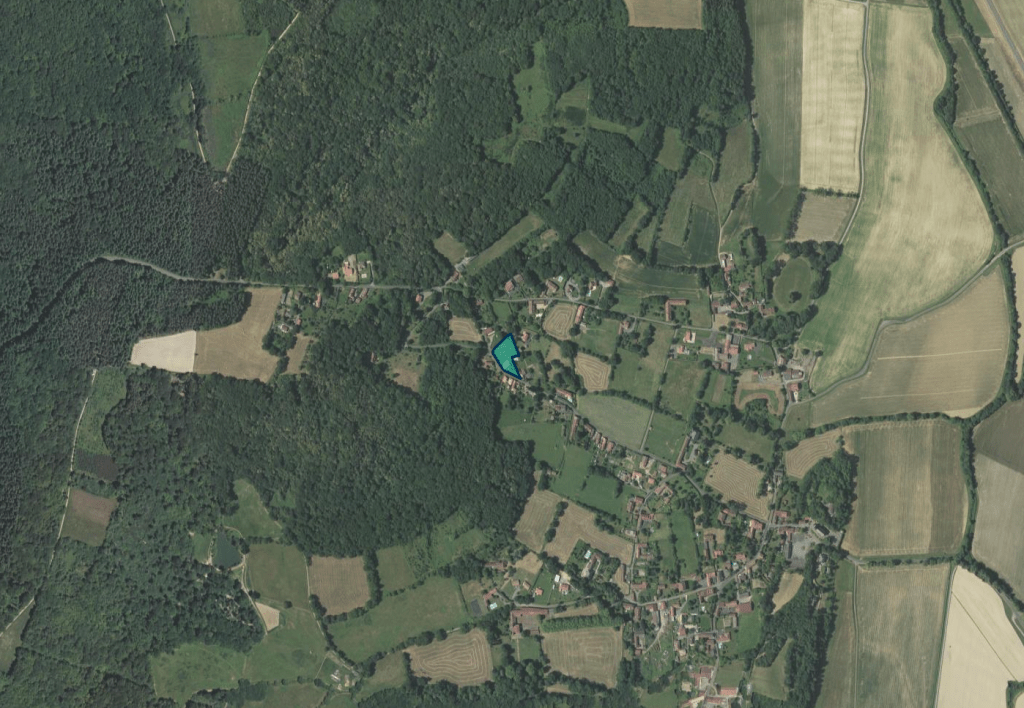
The general lie of the land in the photo above is a slope up from right to left, and the green polygon in the centre is the Project site (at 218m above sea level in the top northern corner). The forested land to the west is on a ridge, rising to 280m along the summit track to the left of the beige-coloured field (centre left).
The land continues sloping down to the village centre to the south-east of the Project site, with its patchwork of livestock meadow, polyculture fields and forest, and further to the east is the flood plain of the local river (the Adour, not in this photo), with the contrast of the large industrial agriculture crop fields which characterise the valley.
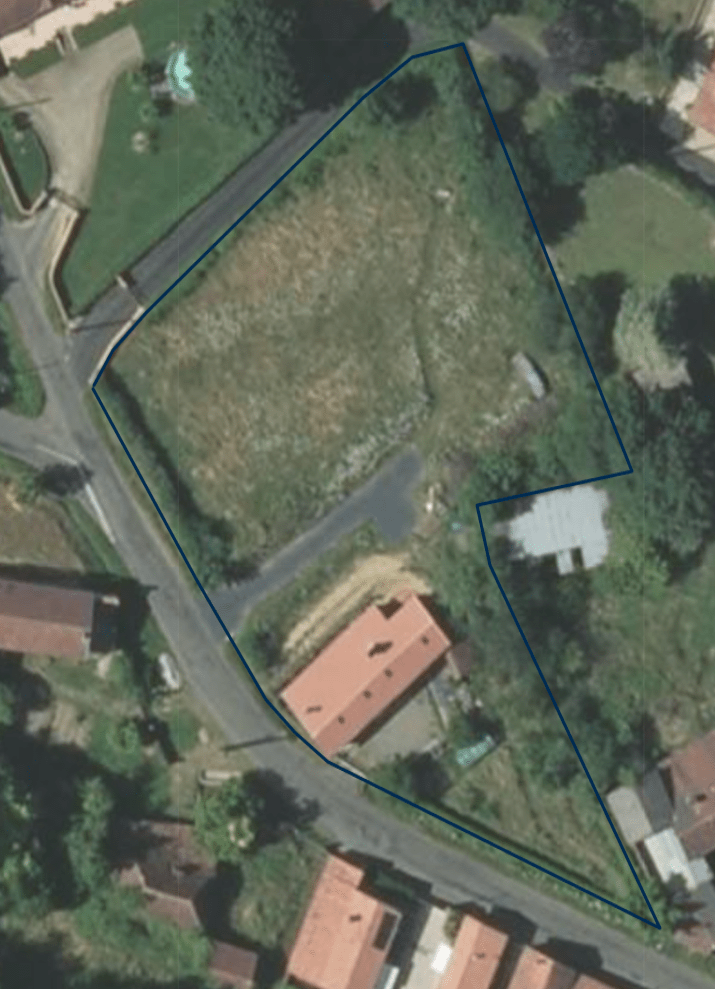
The photo below shows the boundary of the site, enclosing an area of 3112m2 with a perimeter of 267m. The fall of the land from the highest point (top northern corner) to the lowest (bottom south-eastern corner) is 9m, with an average slope of about 5%, which reaches 19% at its steepest point.
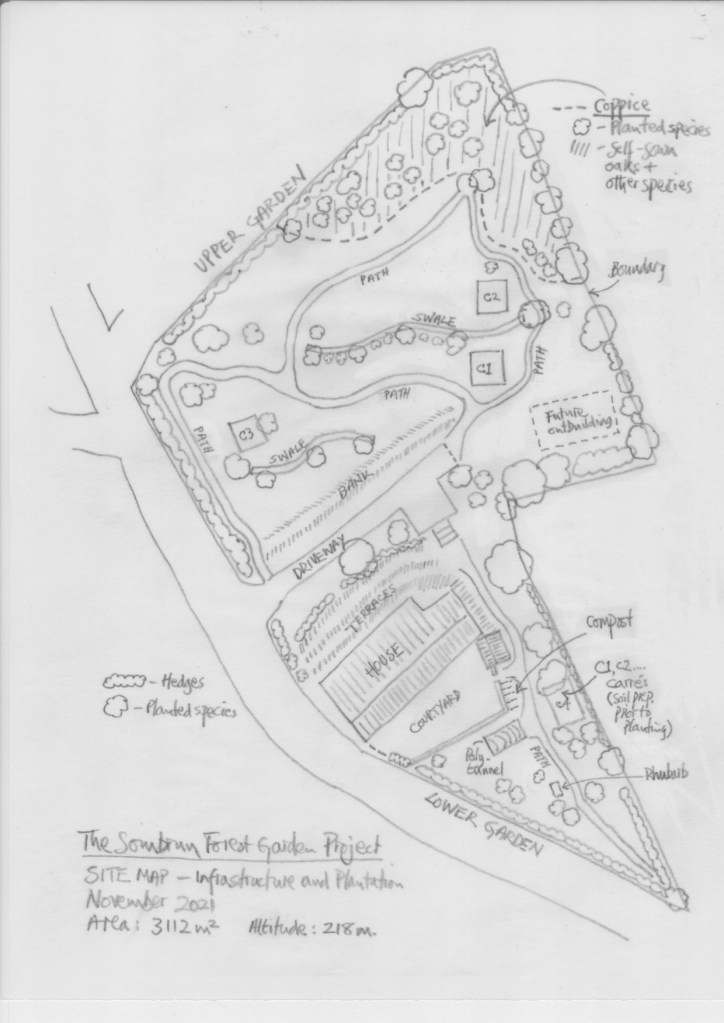
The Site Map above, completed in November 2021, shows fixed infrastructure such as buildings, pathways and entrance drive. Trees and shrubs to this date, either previously existing or planted, are shown as bubbles, and will eventually occupy more space than that shown here. The map will be updated each year, probably in the summer, as more plants are added over winter and spring. And there will also be a key to identify the trees, shrubs and other plants.
To put all this into context, we need to go back, through a lifetime of blindly trying to deal with mental health issues and many false beginnings, suddenly arriving at a point where the Sombrun Forest Garden Project and the realisation that the health of the land and human health are two sides of the same coin, have opened up before me. I always felt deep down that the life I led had no meaning for me, but that the ‘right way’ was as yet unknown.
And I have always been drawn to natural healing and to trees – I remember writing a short story about a boy in a wood, where the trees were the main characters, when I was quite young, maybe 11 or 12, and then one of my career options after school was in forestry, but somehow I got into something completely different, and only started to get back on track 30 years later! ‘Alternative’ medicine, too, has always been an option for me, and in fact the two small, organic farms I established between 2002 – 2015 were based around medicinal plants. They weren’t really a success because I see now I went about it in the wrong way, but I learnt a lot during this time.
And now medicinal plants are already naturally a part of what is growing here, but this time for my own use, not for commercial reasons. They are one of the key elements in the forest garden tradition, and I’m pleased to include them in my work. We can learn a lot from the indigenous tradition of forest gardens, which is truly holistic, producing food (and not just any food!), fodder, timber, fibre, medicines, biomass, shade, water and so on from its various vertical layers, while at the same time following Nature’s example for soil improvement, biodiversity and co-operation. It is the inspiration for my work here, and I am lucky enough to have worked with native peoples in their forest habitat in several parts of the world. (Incidentally, semantic sleuth that I am, I prefer the French autochtone instead of ‘indigenous’, as indigène is colonially nuanced, and it’s a lovely word anyway! It can also mean a rock made up of constituents formed locally, which seems rather fitting as well.)
Over the months that the Project website has been in existence, you may have noticed that I always include items in the Blog which give a wider perspective on the world of trees, forests, agroforestry and forest gardens, and I don’t hesitate to say that the Project is a (small) part of something global – such modesty!! But this is because we are all, all life, a part of something much greater than the sum of us, Nature, and we need to have the humility and imagination to recognise this.
And we are all, every living thing, ultimately responsible for our own health, especially our own immune system: trees do it, animals do it, insects do it, lichens do it, mycorrhizae do it, bacteria do it, mostly in intricate symbiosis with each other. Lichens, for example, only exist through the cohabitation and co-operation of fungae and bacteria. Of course, under normal circumstances we do it too, but in just the last couple of hundred years we have decided we know better than Nature (who has been perfecting that amazing, self-healing organism the human body over millions of years) and invented pesticides, food processing and allopathic medicine!
We each of us know our own needs better than anyone else; it’s just that we have forgotten how to understand what our bodies are telling us. But in this context the approach of allopathic medicine (treating symptoms not causes; ‘one size fits all’ for every, unique, patient; increasing instead of reducing toxin levels in the body; ignoring the body’s own immune system) misses the point.
I don’t know who came up with the name Homo sapiens, but it seems to me we haven’t been behaving very wisely this last hundred years or so. If we continue to isolate ourselves as superior to everything else, and with a blatant disregard for the planet’s natural systems, then it doesn’t take much to work out what the result will be. For me, we need to re-learn that idea of co-operation and respect, to climb down from our ivory tower and regain our place within the web of Nature.
The Sombrun Forest Garden Project is about the land and a rejuvenated Homo sapiens as partners in symbiosis, and is as much about health, nutrition and the connection to something much wider, as it is about growing trees and food, since these things apply equally to both the plants and the person working with them, under the forgiving eye of Nature.
So what lies ahead? A clearer idea of where this Project is headed, for sure. After all my dallying over design (see recent Blogs), the above Site Map, which is historical rather than hypothetical, in the end provides inspiration for what is to come by showing the potential alongside the actual. Maybe this is what I needed to do all along! The area of the upper swale, for example, between the two pathways, seems to call out for the next stage of development, and probably Carré 5 will be to the left of the space above the swale.
So the idea taken from Jane’s patchwork (Blog, July 1st, 2021) is actually happening; Carré 1 will be planted up this winter (see the current Blog), and Carrés 2 and 3 will be getting the lentil treatment (Blog, July 1st, 2021) next spring. My idea has always been, and remains, that the Forest Garden will sweep outwards and downwards from the Coppice, an area which began all by itself, as in a natural forest, and link up both above and below ground with the various nitrogen-fixing areas and mycelial networks already being established.
But the over-reaching aim for the Project remains the same as I originally wrote when the website was launched in April 2020 – “to establish a working forest garden on a 3000m2 site in rural south-west France, following principles formulated over many thousands of years in full respect of Nature, the environment and ecology”.
Why did I buy this particular property at that particular time and decide to start the Forest Garden Project? Who knows ….. but without doubt, all the varied experiences of my earlier life, far from being time wasted, were the foundation stones building up to what is happening now. The more I work on the Project, the more I become entwined in everything that Nature and the Forest Garden have to teach me, and the richer and healthier we all become!
 The Sombrun Forest Garden Project
Hello Jonathon,
It is very interesting to read about your Forest Garden Project. I learned about your project initially from my dear friend Geoff Lau who has spoken of it several times now and pointed me to your blog. He would know that I share a lot of your thoughts and ideas, although I do not have a large enough patch of land to put into practice what I would love to do, which I realise from reading your blogs, is something quite similar to your Forest Garden. That said, I’ve always grown vegetables and some fruit, and I get by with a suburban back yard and 5mx5m plot in a community garden. Here I grow a lot of what much of what I consume during the year: tomatoes, garlic, onions, beans fresh and for pulses, eggplants, capsicums, leafy greens etc along with feijoas, raspberries, lemons and figs. I preserve / freeze /dry as much as can as well as giving it away.
However, I love trees and for a long time I have despaired at the amount of deafforestation that has been happening here in Australia since white settlement and the consequent land degradation that has occurred as a result of that. I grew up on a farm where land clearing destroyed the agricultural viability of the land on our farm over the relatively short time of 100 years. Despite that, the prevailing attitude when I was growing up on that farm, (around a 100 years since land clearing started), was that ‘the only good tree was a dead tree’ and as children we were sent out to ring-bark wattles (acacias) and anything else that was not large enough to kill us if it happened to fall on us while it was being felled. Of course, I realise now 50 or so years later, that these wattles were the pioneer species trying to revegetate the now degraded and bare land and should have been allowed to have their way! Anyway, after we walked off that farm, because it was by now overrun with rabbits and no longer viable, and moved to the city I became over time, more and more aware that we had to put the trees back into the landscape to stop it being eroded and for the topsoil to be lost during our (frequent) droughts.
Now that I no longer have to work in paid employment and the kids have gone (except when they need to come home for a while to save money :-)) I am learning about ecosystems, the role of trees in them, and regeneration of bushland near where I live, as well as along the east coastline. This (partly government-funded) ‘Landcare’ involves some planting of native species (trees, shrubs, grasses etc local to that area), but mostly it involves lots and lots and LOTS of weeding and removal of invasive non-native species because these unfortunately out-compete the native vegetation. Once these are controlled the native vegetation starts to come back, as do the native birds, who play a big part in spreading seeds and helping to establish plants naturally. And since you mentioned fungus in a recent blog, I am only just now learning about how important fungus is the soil for the health of trees and other plants. Some of our native plant species will only thrive in a soil that has micorrhizal fungus present as there is a symbiotic relationship between the two. Amazing!
Well, I’ve gone on long enough already, but to conclude, it has been great to discover your articles and blogs. Helen
LikeLike
Hello Helen, thank you for writing and it’s nice to meet you! Even if you think you don’t have enough space for a forest garden, you can always follow the principles (multiple ‘layers’, close planting, biodiversity, etc) and scale down to suit what you have. I’m sure from what you write that you already have the right approach to do that. And you are quite right, too, in thinking that trees are the key to it all, except that in your case the woody plants could possibly be the shrubs, which would become the canopy, and so on. Don’t worry too much about ‘controlling’ the ‘weeds’, nature will find its own way, and you just need to facilitate it by reducing competition around the plants you are nurturing, and leaving the rest; they are providing valuable ground cover after all. Best wishes
LikeLike