Since the last Blog in mid-April, we have had just over 220mm of rain, a lot! It was spread over the whole of this period, but with a peak from a series of heavy thunderstorms in the last 10 days. There was a particularly violent one on May 28th, when 44mm fell in just over an hour (there was probably more than this, because at one point it was falling so heavily that the opening of the rain gauge wouldn’t have been able to cope with it all). The storms, which usually occur at the end of a very warm afternoon, seem to have become a fixture, and are the result of a high pressure system which is stuck over the British Isles, blocking the depression over the whole of southern France.
The rain suits me just fine, because the garden is at last getting moisture at depth, something which it didn’t have for the whole of last year. And the result is clear to see. Suddenly, trees and shrubs appear to have put on a spurt (see photos below) and everything is looking vibrantly green and healthy. And in many cases this has coincided with the amount of time which trees planted two or three years ago need to really get their root systems established and to start showing proper growth.
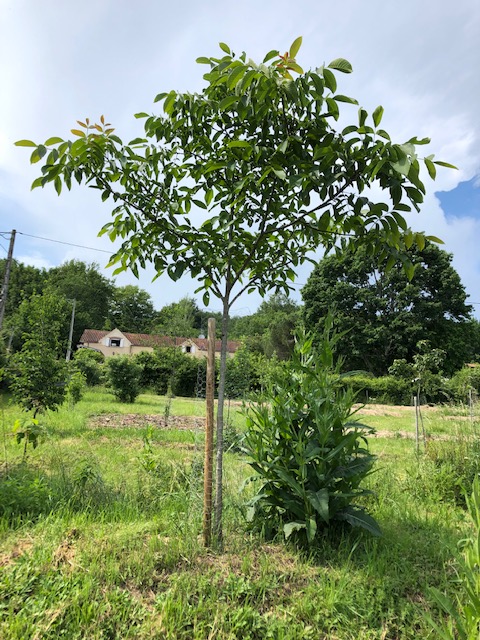


Top left, the walnut planted last year was already a good size, but it has more than doubled in volume since. The plant to the right of the walnut is a self-seeded teasel (Dipsacus spp.) which I like to have in the garden.Top right, a robinia (Black Locust) in the Coppice area is suddenly looking like a tree! Bottom, lush growth in Carré 1, showing the ground-cover raspberries, two jostaberry bushes and an apricot in the background, all planted about 18 months ago. Apart from the rain, growth here will also have been helped by the natural soil enrichment process the Carré has received over the last two or three years.
The new Hügel beds and the existing swales (see Blog, April 15, 2023) will be playing their part too in water retention on site, and they will have an even more crucial role to play in the future for moisture and humus, as planting continues, plant density increases, and trees and shrubs mature.
The difficult choices mentioned in the headline involve dealing with the ever-present deer problem in the Forest Garden, and how to manage the important wild flower population here.
I said quite emphatically in these pages a couple of years ago (Blog, May 1, 2021) that deer-fencing the Forest Garden was against the ethos of the project, and that I was going to find a way to live with them, rather than against them! The reality is that they are a persistent nuisance, with a partiality for apple, eleagnus, oak and chestnut, either nipping out the growing tips or rubbing away the bark, and sometimes even ripping off the wire protection; this will only increase as more and more juicy young trees and shrubs are put in, not to mention any future herbaceous plants that they take a fancy to, including annual food plants (for an interim solution to this particular problem, see below).
So, I am faced with a choice of accepting the damage and the inevitable increase of unsightly and restraining wire cages around each tree or shrub, or of reluctantly (and expensively) installing some fencing; this would actually be quite a straightforward matter on just two sides of the Upper Garden and a small area in the Lower Garden, the rest being already adequately protected. To keep it in perspective, the damage caused is not huge, admittedly, but it’s a constant thorn in the side, and I go out each day wondering what they have done overnight!
This year I have decided to grow a few annual vegetables both from plants raised in the polytunnel and from others bought from a local organic grower, and to anticipate loss through deer browsing, I fenced off a small 10 square metre rectangle (see photo below) and planted tomatoes, peppers, aubergines, cucumbers and squash. I chose an area that had previously been under a pile of woody biomass (used in the Hügelkultur beds), so the soil should be carbon-rich, and I added green matter, compost and a bark mulch. Early days yet for these plants, but they are all looking healthy.

As mentioned last time, I have sown both Carrés 2 and 3 in the Upper Garden with dwarf French beans (photo below), and these are now growing away. Difficult to see in the photo because the young plants merge with the background, but you can probably make out three or four rows out of the six sown; each carré has about 150 plants, so I shouldn’t be short of beans this summer (depending on whether the deer like them or not)! The beans of course are only part of the objective, which includes nitrogen-fixing and ground cover as well.

My other hard choice involves the wild flowers here, which, until 2021, were the subject of a monthly census. I stopped doing this as it became clear that the populations were much the same from year to year. The importance of the considerable number of wild flower species (over 100 at the last count) as part of the insect habitat and overall ecosystem of the garden, cannot be overstated, but I recently mentioned (Blog, April 15, 2023) that after last year’s drought there was also a considerable fire risk, from the tall, parched grass that was left after the flowers were over, for both my property and those surrounding it. I could not afford to let this happen.
So this this year I decided to (more or less) keep up with the growth of the grass by strimming at intervals. I have managed to keep clumps of wild flowers as I come across them, but inevitably many are cut down and also the ground habitat for all those insects, herbivores and other organisms is put in danger. Many of the wild flowers will be pollinated by, and food for, one particular insect, and so by removing the flower I am destabilising the ecosystem for the whole garden. I think for next year, a compromise solution might be to leave everything until the end of June, by which time most of the spring wild flowers will be over and seeded, and many of the fauna populations through at least one reproductive period, and then cut the grass. We’ll see!
While on the subject of flowers, I decided this year to sow some useful ones in the polytunnel, to include them throughout the Forest Garden as insect attractors, for medicinal and culinary use, and as a pest repellant in the new potager. These are echinacea (Echinacea purpurea), marigold (Calendula officinalis), camomile (Matricaria chamomilla), ‘French’ marigold (Tagetes spp) and an interesting culinary plant called Korean perilla (Perilla frutescens), extensively used raw or cooked in the cuisines of that region, with flavours of mint, basil and sesame.

The photo above is of a hop plant (lower foreground), one of several planted in a sunny spot at the end of the drive. You can probably make out a tendril that it has already produced, climbing up into the ivy above.
I have already been harvesting other young and tender leaves for salads recently – these include dandelion, small-leaved lime, silver birch, white mulberry and vine – plus nettles and hawthorn flowers for drying for herbal tea. There have also been wild strawberries and of course rhubarb for compotes and jam.
There is also fruit coming for later on – greengages, persimmon and mirabelles on older established trees, and a smattering of cherries, quince, apple, pear and peach on very young trees. There are one or two almonds and I think we should get a reasonable crop of walnuts this year from the older tree. It is disappointing that there have been no cherries to speak of from the mature trees, and it looks like there won’t be any figs either, I don’t really know why.
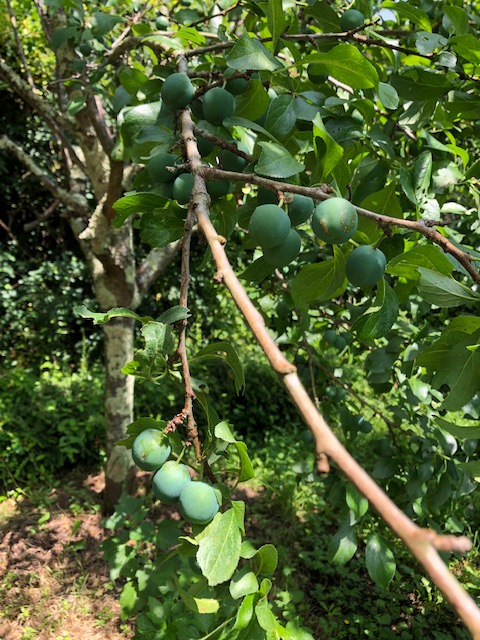
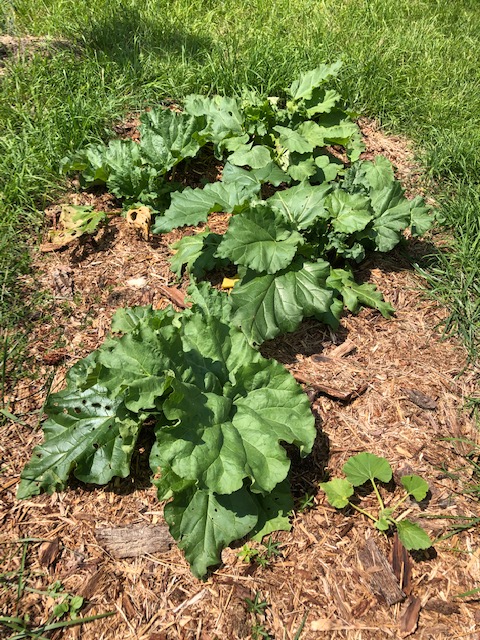
The greengages are already of a good size (above left), and I have improved the rhubarb bed (above right) with compost and bark mulch. An unidentified courge plant has also appeared, bottom right. The seed must have been in the compost.
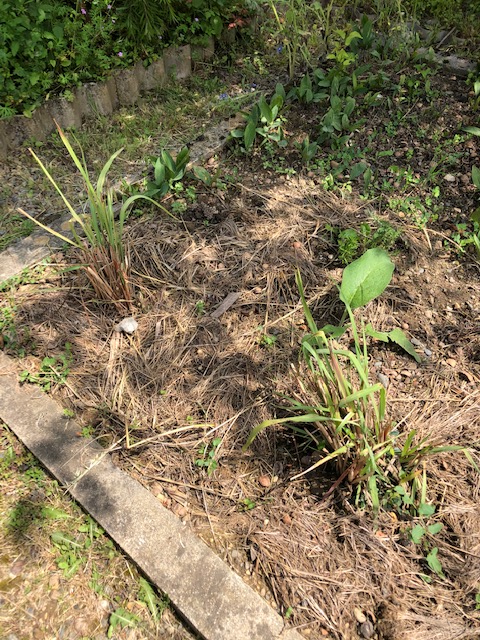
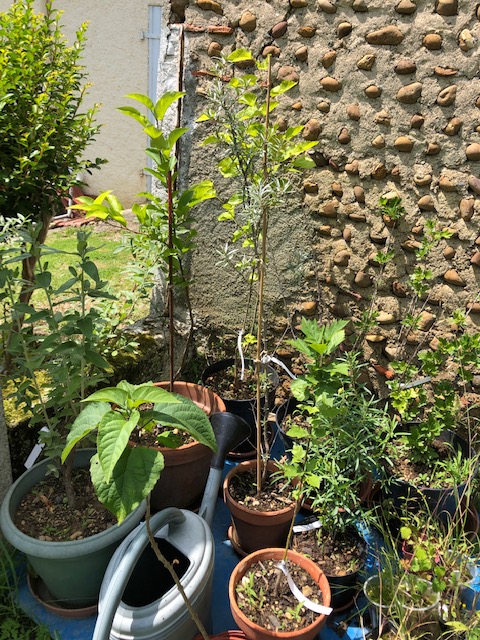
A friend gave me some lemongrass (above left), so this has been planted in the courtyard bed, with some comfrey for company. The photo above right shows my pépinière, young trees that I bought last winter and am growing on in pots this year to develop their root systems before planting out. There is a wild service tree (Sorbus torminalis), a second white mulberry (Morus alba), a Kazakhstan apple (Malus sieversii) (a wild apple that I have always been interested in, because nearly all the hundreds of apple varieties we have today came from this one species), a Russian olive (Eleagnus angustifolia), sea buckthorn (Hippophae rhamnoides) and gooseberry (Ribes uva-crispa).
The paulownia hedge at last seems to be getting established (below) – I had to replace nearly half of it after the drought last year, and luckily there were enough spares. As you can see, a good number of the paulownias are already producing their huge leaves, so it’s looking good for biomass production, part of their raison d’être. And that’s my original robinia in the photo, the very first tree that was planted for the Forest Garden over four years ago, when it was a little sapling not even as high as where the leaves begin now.

While all this has been going on, there has been a background accompaniment of strimming, strimming and more strimming! With all the rain and the usual season for lush grass growth, it has been an endless task, but with the arrival of June it should (or might) start to slow down a bit.
I have also found time for a bit of baking! My comments in the previous Blog about bread-making may have sounded a little self-satisfied, and it’s true that at the stage I have reached, I can reliably produce a good loaf. But this is only the beginning; now that I have a technique, I can start to branch out a little more with different types of flour and bread. The two loaves on the left below were made with 50% rye flour, which was a bit of a risk due to the denser quality of the rye, but they turned out fine, probably the best so far in fact, and a friend has asked me when I am going to try a pure rye loaf! Maybe I’ll give it a shot! The fruit cake was made because I had a lot of eggs a neighbour had given me to use up, and that turned out well too.


 The Sombrun Forest Garden Project
Hi Jon,
I always read your blog with pleasure and interest. I thank you for sending it.
About cutting grass. In Ableiges we have resisted cutting the grass, which has grown very high, this year. My mother always said « no mow May » and would resist cutting the grass until June for the sake of the insects etc.
Of course everything is changing !
Love Siân
PS Am enjoying the Attenborough programme:
Seven continents One planet on BBC IPlayer
LikeLike
Hi Siân. Thank you for your kind comments, it’s always nice to hear. And thanks for the ‘recette de grandmère’ about cutting the grass. I guess that’s the conclusion I’ve come to!
LikeLike
It’s lovely to see your garden beginning to mature, Jonathan. These big projects require so much patience while nature does its thing! I would love some of that rain, we have just had the second month without a drop since the beginning of the year, it is very hot with a strong drying northerly wind and starting to look more like August. I’m impressed at how well the beds are holding up thanks to lots of organic matter and mulch but some plants, especially seedlings and new transplants, are struggling. Potential storms are forecast at the weekend, I’m not keen on the damage they do but I will be out dancing in the rain if it comes. I empathise completely over the deer issue, they are so destructive (we have hares, too, and a rabbit has joined the party this week). They have eaten the top out of every young tree and hedging shrub we have planted and stripped the bark from some, too. If only they would let everything grow a bit! Luckily, the vegetables aren’t bothered too much, we have netted the sweetcorn and some brassicas temporarily against hare damage but otherwise it all has to take its chance. The joys of gardening with and for wildlife! Your baking looks great, good luck with the 100% rye loaf!
LikeLike
Thanks for the comment, Lis, and I sympathise with the problems you are having! I really do hope that we don’t have such a severe drought again this year. Last year was pretty taxing for all concerned – me and the garden! I forgot to mention in the blog that another reason for planting so many beans is that I hope to have some left after the deer have had their share! If I do do a pure rye loaf, no doubt it’ll be in the Blog. Our nightly storm is beginning to rumble in as I write.
LikeLiked by 1 person
I do love reading your updates, Jon! I am writing to you at our old school, waiting for the OS AGM to kick off. I saw Peter last evening and I said the he may come and see us this summer. Maybe we would could all get together.
As ever,
Tim
LikeLike