The Forest Garden inventory, first started four-and-a-half years ago, has been revised and updated. It was previously organised by area, but I realised that this could lead to duplication where there was a species in more than one area of the garden. So plants have now been arranged by type – hedges, forest trees, fruit and nut trees, fruiting shrubs and climbers, introduced flowering plants and perennial vegetables – and alphabetically this time. There are still one or two duplications, for example hawthorn, which is both in hedges and forest trees, but these are minimal. Nitrogen-fixing trees and shrubs are also indicated. As before, wild flowers are not included in the inventory, as they have their own.
With nearly 80 different species throughout the garden, all with their own degree of usefulness, it’s a good start for the Project, just over four years in, and a significant increase from the 50 species noted in the Blog, January 1st, 2021!
As time goes on, the two sections in the Inventory which are under-represented at present – introduced flowers and perennial vegetables – will increase, as canopy- and ground-cover are developed.
My concept of a forest garden is a predominantly perennial one, with some annual plants (i.e. vegetables) put into the mix from time to time. The reason that I give reduced emphasis to annual plants, as mentioned in several previous posts, is because most of them need a lot more preparation and care, and are very demanding in water and fertilisation, by their very nature. They also take from the soil, without giving anything back (legumes are the obvious exception) and are susceptible to pests and diseases. The whole point of the forest garden to my mind is to provide robust, biodiverse perennial plants of all types that will grow and work together in close proximity to improve soil, water retention and ecosystem development, have a multitude of uses, be very economical in terms of space used and maintenance, build their own pest and disease resistance, and give abundant crops year on year.


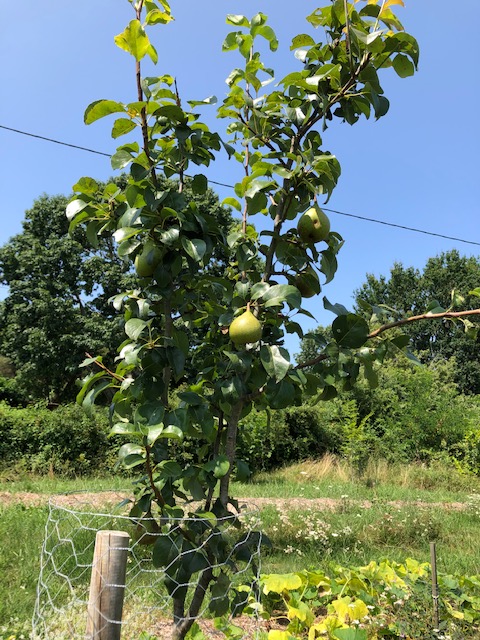
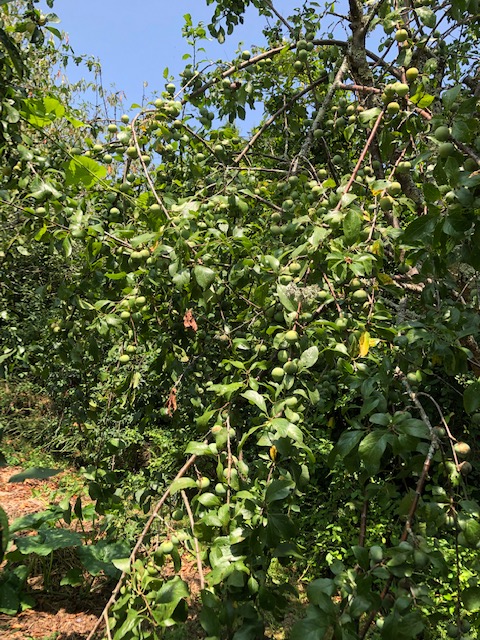
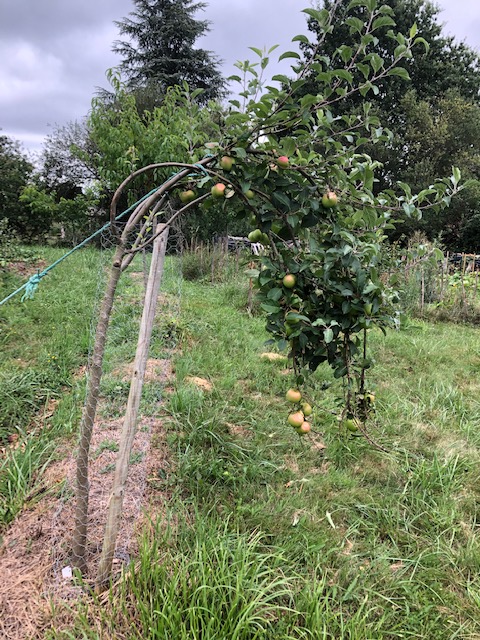
Left to right, top to bottom: An abundant mirabelle crop; plenty of young figs forming; there are a few pears on this young tree; the heavy greengage crop is weighing down the branches … as is happening on the young apple tree too. I am supporting this tree until the apples are harvested and will then decide if pruning is required later on. There is deer browsing on the low-hanging branch tips; just the new shoots, not the apples!
One recent meal here included perennial salad leaves (horseradish, vine, birch, lime, white mulberry and dandelion), cucumber and dwarf beans (annuals), rhubarb and raspberries – all from the garden and very rewarding to have at this early stage in its development – with home-baked sourdough bread and Pyrenean sheep’s cheese, followed by a mug of nettle tea! I have also had small amounts of cherries, peaches, ground-cover raspberries and wild stawberries, with a few apples and hazelnuts to come. There will be a lot of autumn olive berries and blackberries this year, and from the established trees there will be plenty of mirabelles and greengages (imminent), plus figs, persimmons and walnuts. What a change from last year!
Incidentally, the perennial salad leaves mentioned above, apart from being tasty, contain high levels of vitamins and minerals which make them a valuable ingredient in a salad meal.
You might think that it’s a shame to deny oneself the pleasure of growing, harvesting and eating crops such as tomatoes, carrots and salads for example, but vegetables and salads I haven’t produced in a particular year I buy on local markets from organic growers, from whom I can get excellent seasonal produce for a reasonable price without having to cope with gluts! And I think it’s important to support them too.


The vine planted under the mirabelle tree last year (left) has shot up and is now coming out of the top! This pumpkin (right), planted near the same mirabelle tree, has spread across and wants to be a vine! If I left it, I think it would climb up next to the vine.
A word on the dwarf (French) bean crop (see last month’s Blog); the large quantity planted has paid off, because although there has been some deer browsing, they have restricted themselves to the edges, leaving plenty for me in the middle! I have been harvesting for about 10 days already, and there are still more to come. Most of them have been blanched and frozen for use over the next few months. And of course, there’s gifts to, and exchange with, my neighbours – I have just given one lady a bag of beans and received a pot of apricot jam in return! All part of the forest garden social network!
The weather has certainly been interesting since the last Blog at the beginning of June! Since then, we have had about 140mm of rain, a lot of thunderstorms (almost daily at one point in the middle of June), with two particularly violent ones on June 21st and July 7th, both thankfully without hail, although the most recent storm on July 23rd did include some tennis-ball-sized hailstones, enough to cause just-perceptible dents in the car and weaken but not puncture the plastic of the polytunnel. The July 7th storm snapped off a young apple tree at its base, and wrenched a branch off a dogwood tree, spreading the tree outwards from the centre; the wind and rain were for a short time almost tropical in intensity. Some of my neighbours had parts of large trees split off down to the base, a curious phenomenon, possibly suggesting a tornado-type wind. I guess I got off lightly. The last two weeks in general though have seen calmer and more pleasant weather, with temperatures rarely over 30°.
I am relieved that so far we have escaped last year’s heat-waves and drought (but there is still time!), so that I have only needed to water moderately the annual vegetables and very young trees. Extreme conditions are continuing in the region, however, with the recent heat dome over Italy extending into south-eastern France, giving temperatures around 45°C, and violent storms causing devastation in towns and to crops.


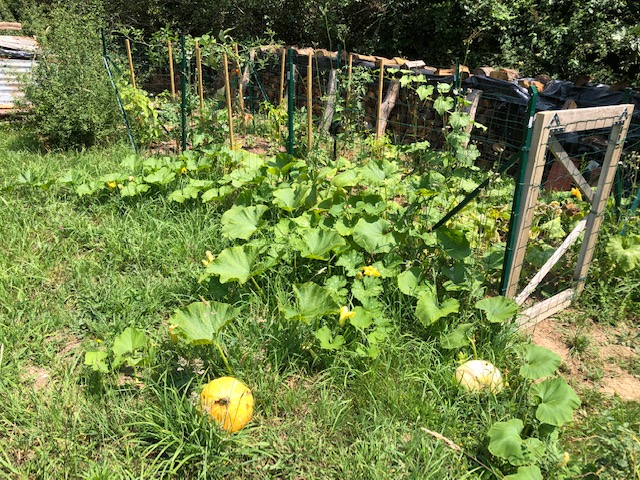
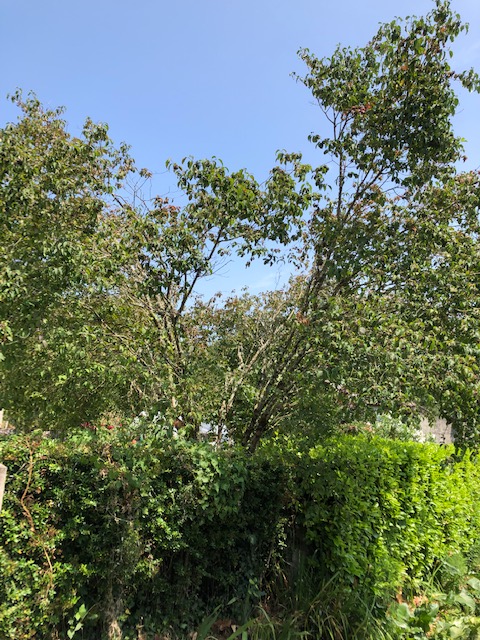
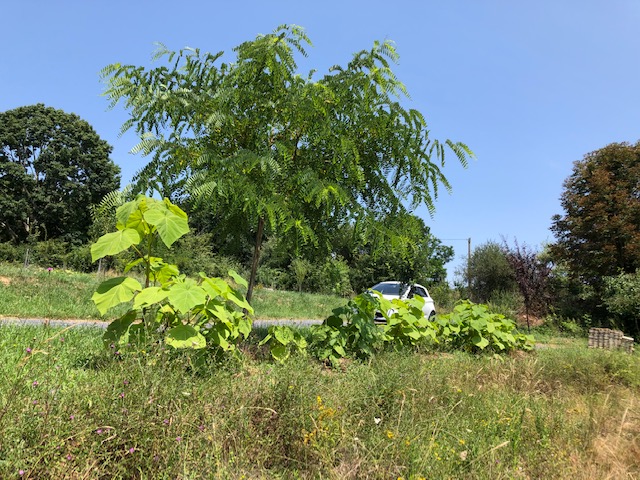
Left to right, top to bottom: The French beans, where there has been deer browsing along the edges; ground-cover raspberries, which have a more delicate flavour than the standard ones. Planted in Carré 1 last year, the four plants have already covered about 65% of the area; squash escape from the vegetable plot; this dogwood tree was splayed out in the storm and the central branch snapped off; paulownia hedge and robinia growing well. I think the paulownias under the robinia may suffer with less light, but they may decide to catch up.
There has been a lot of garden maintenance work over the last few weeks as well. With the wet and warm weather, everything has been growing rapidly, so I have needed to strim a lot, cut back bramble in various places to stop it taking over, trim roadside hedges, plant out flowers grown from seed, remove unwanted weeds growing through on the new hügelkultur beds, clear suckers from the goat willow I coppiced a couple of years ago, and re-stack a log pile that had collapsed due to the wet ground.
Bread-making has become a regular Friday activity, and I have learned to have another task or tasks on the go at the same time, so that I am not waiting around for the dough to rise! It also works well to prepare the dough in the afternoon and early evening, prove overnight in the fridge, and bake early on the Saturday before I go to market; the slow second fermentation allows the flavour to develop more, and gives a firmer outer ‘skin’ to the dough. There are usually two loaves, and I have recently increased the ingredients to make each one about 500g, which is ample for the week. I am still pleased with the results, and it is very rewarding (and healthy!) to have it as a part of my daily meals.
Podcasts are a favourite pastime these days, and one that is always interesting is The Infinite Monkey Cage, which discusses scientific topics with experts in-depth, but in a light-hearted manner. The current one, The Magic of Mushrooms, is a fascinating review of the history, astonishing scope and versatility of the unseen, subterranean mycelial world and how fungi work in symbiosis with trees, is very relevant to forest gardens, and well worth a listen. The panellists on this occasion, biologist Merlin Sheldrake (author of Entangled Life, reviewed in the Blog, December 1st, 2020) and mycologist Katie Field, are both top-level scientists who are able to communicate their considerable knowledge in an engaging and down-to-earth way.
 The Sombrun Forest Garden Project