I’ve chosen to publish this Blog on the Equinox, the first day of autumn. It’s an appropriate time to reflect on the summer, and in particular on what it brought in terms of crops and the weather.
Given the age of the Sombrun Forest Garden Project (four years since planting work really began), it’s gratifying to be getting some harvests in such a short space of time – even if in some cases they are very small … !
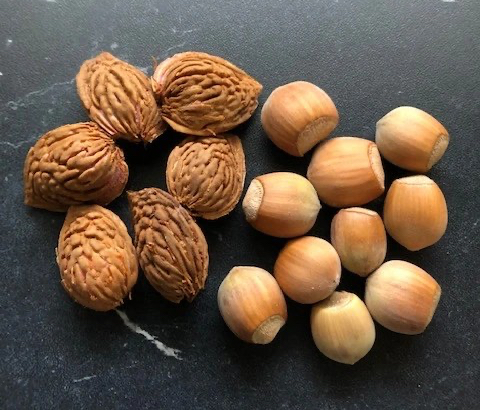
Almond and hazelnut harvest 2023 – well, it’s a start! I had forgotten the intensity of flavour in a fresh almond, and the beautiful design of the shell. The walnut planted two years ago (below) has just a single nut, but even this is surprising given its age (4 – 5 years) and the fact that walnuts can take up to 8 years to start producing fruit!
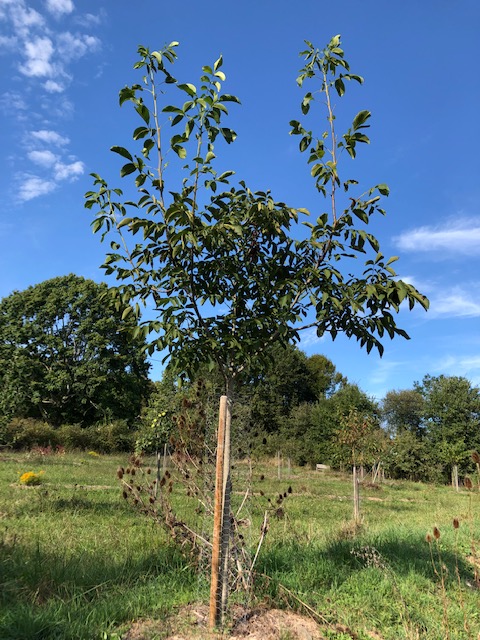
The new walnut, showing the growth it has made this year (above the main mass of foliage). It is obviously happy here, probably because it is on a bank of topsoil made when the driveway was created, and because a large amount of woody biomass was placed all along the back of the bank.
All together this year, there have been cherries, blackberries, greengages, mirabelles, figs, autumn olives and apples, plus the few almonds and hazelnuts shown above, not to mention a variety of salad leaves from trees and other plants (Blog, July 24, 2023). The walnuts on the mature tree are beginning to fall, and there is quite a good crop this year. There will also be quince (see below) and persimmons, although many immature fruit of the latter have started to drop, I’m not sure why.
The small annual vegetable plot I set up (Blog, June 5, 2023) has been surprisingly resilient, probably because it is on the site of a previous woody biomass pile, and it had a liberal covering of bark mulch to keep the moisture in. From it, there have been tomatoes, aubergines, peppers, chilis, cucumbers, physalis and squash – just small quantities, but worth having. It was surprising to get any tomatoes at all, because they started to rot after the wet weather in June, but then partially recovered.
The two French bean carrés (Blog, June 5, 2023) provided an embarrassment of beans, despite the attention of the deer, and I have a good stock in the freezer even after giving a lot away. They cropped for maybe six weeks, and even the less healthy-looking plants kept on producing! The plants and any remaining beans have been left in situ to rot down and provide more nitrogenous material.
All in all a satisfactory result, not just from the fruit and vegetables provided, but from the wider angle of what a forest garden means. As you may know by now, I’m not after just “production” or “self-sufficiency” (although this will probably come with time), but something much more significant. It will be through natural soil improvement, biodiversity increase, ecosystem expansion and consolidation, and contribution to the whole local environment that the Sombrun Forest Garden Project will achieve its goal. And this is something that will not only happen in 10, 20 or 50 years’ time: it’s happening now, building every day, although you may not be able to see it. This is the result, and it’s what encourages me to carry on.
It’s probably relevant here to refer you to my Article No. 3, published exactly three years ago today, which deals with ‘the bigger picture’, something I have always felt strongly about, meaning that the Project here is just a tiny part of something much more global, and of which we are all a part. The article is as relevant today, perhaps even more so, than it was in 2020.
This year has been a relatively quiet one in terms of planting development in the garden, but a lot has obviously been going on, as the harvests and plant growth and consolidation show. And this is all the more remarkable given the battering the garden had with climate conditions last year.
In terms of processing the harvest, figs, greengages, apples and mirabelles have been dried or made into compotes, with more of the same fruits plus blackberries put whole into the freezer for processing when I have more time – jams, compotes or simply stewed. Some figs with ginger and red wine have made a delicious compote this year.
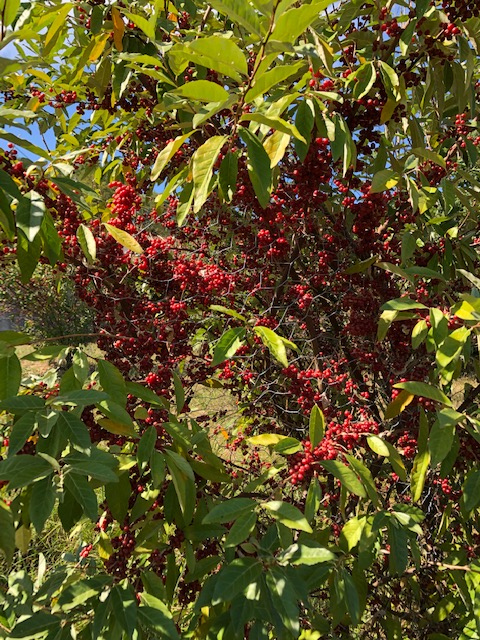
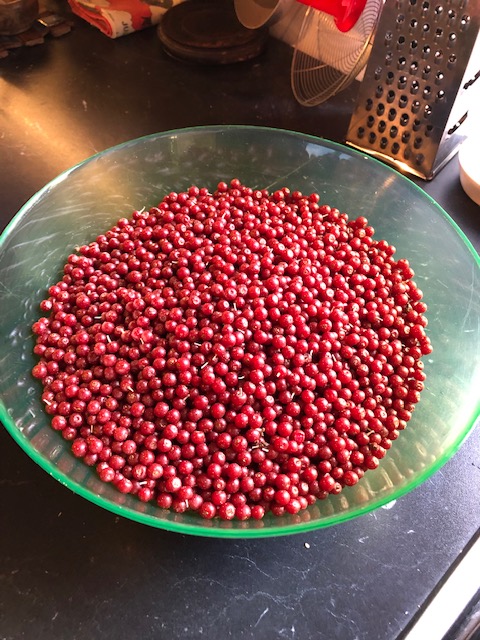
There was an enormous crop of autumn olives this year (see below), and I didn’t manage to find the time to process them all for fruit leathers. But others were no doubt happy about that!
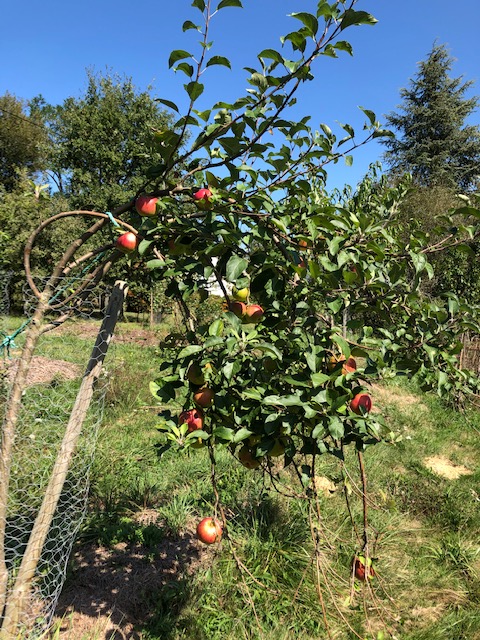
I mentioned in the last Blog (July 24, 2023) that the apples on one of my young trees were weighing down the branches (see more recent photo below, left), and I was wondering whether to prune or not after the fruit were harvested. I have since done some research on this variety, a local one called Pomme d’Albret*, and discovered that it is a characteristic of the cultivar that it produces tall, willowy branches that then bend down with the weight of the fruit. So my thoughts about pruning have gone out of the window, and I’ll just watch and wait! Anyway, Pomme d’Albret is a late-maturing, firm variety which is very versatile and can be used for eating as well as for cooking. I’ll be picking them in a couple of weeks, if the deer don’t knock them off first. You can see where they’ve been browsing the tips of the branches near the bottom, but strangely, they don’t touch the apples.
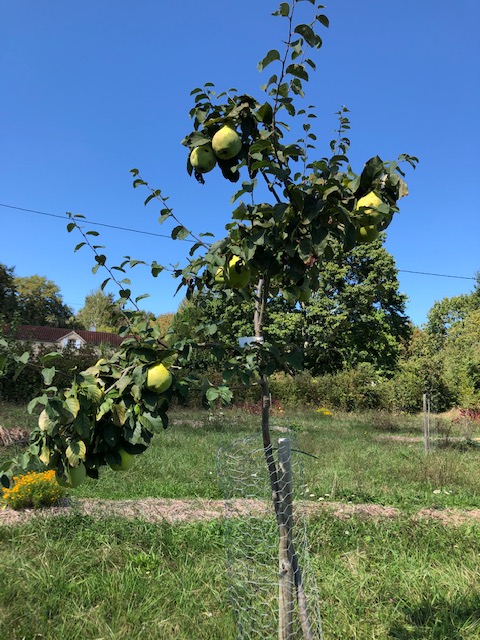
The photo above right shows the quince tree with its spectacularly large fruit, again, almost too much for the young branches. This variety has a lovely name – Coing de la Haie de Thouars – Quince from the Hedge in Thouars (a village about 100km north-east of here)! These too will be harvested soon.
There have been continuing maintenance jobs over the summer – strimming, hedge trimming, cutting back bramble where it was beginning to take over, and some watering. There was much less need for watering this year, partly because we have had more or less sufficient rain, and partly because everything was another year older and so more resilient. The majority of the fruit trees have been planted on or near the swale ditches (see Blog, February 1, 2021 for an explanation of these), and the moisture-retention and mycelial development benefits from these is clear to see.
I only needed to water a little in late July and early September, with a moderate amount during the hottest period in mid- to late August (see also the weather report below). This contrasts sharply with the severe drought situation last year, when I was watering for the whole of July and August and into September.
Due to the potential fire risk of leaving the long grass in the Upper Garden uncut in previous years, I decided to cut more regularly this year (see Blog, April 15, 2023 for a discussion on this strategy). This has turned out to be a mistake, partly because there was sufficient rain that the grass didn’t become parched, and partly because I have been chasing my tail for much of the year to keep up. This was wasted time and energy, and a knock-on effect was that I didn’t maintain my set pathways over the garden, another mistake.
So now the garden is getting its end-of-season cut and tidy, and next year I will return to just maintaining pathways and keeping an eye on the drought situation, benefitting biodiversity and habitats, and only cutting back as necessary to avoid any fire risk. Lesson learned!
Apart from the couple of violent storms mentioned in the last Blog (July 24, 2023), we have had more ‘reasonable’ weather this year in this corner of France. This seems contradictory, because the country as a whole has recorded the hottest-ever day, month and year! We seemed always to be just on the edge. Maybe this was due to influences from the Atlantic and from the Pyrenean mountain chain, and maybe these will play a part in our local weather in the future.
Since the last Blog, we had 10.5mm of rain for the last week of July, 42.5mm in August, and for the first three weeks of September 68mm (121mm in all). It has generally been calm with sunny periods to sunny, and although there were occasional storms, these didn’t have the force of the earlier ones. It became hot in mid-August (30° – 35°), with heatwave conditions in the third week (35° – 40°, and not cooling properly at night). Then there was another hot spell during the first 10 days of September, confirming the climatologists’ predictions that we will be getting hotter weather for longer.
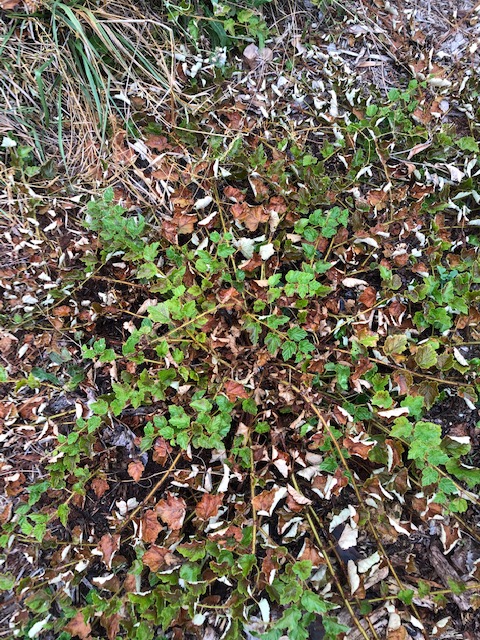
The power of the sun is not to be underestimated, and in a single day (August 24th, when the temperature got up to 40°), several plants in the Forest Garden were literally scorched, as with the ground-cover raspberry (left) and blackberry (right) below. I have learned that above about 35°, plants cease to photosynthesise properly, with the consequent effects on their whole sap and transpiration systems that can be seen clearly in these pictures. Why this is only partial, I don’t know; maybe someone out there has the answer?

There was the usual log delivery at the end of August, and everything is now stacked, both in the garage for immediate use, and outside for future use up to 2025, with kindling wood also prepared. Everything ready for a snug winter!
* The House of Albret was an important seigneurie or lordship covering a large part of south-west France during the 14th – 16th centuries, and with close ties to the French royal family. Jeanne d’Albret was the mother of Henry IV of France. When I first moved to France, I lived in a village called Castelmoron d’Albret, which has the distinction of being the smallest commune in the country, just 4 hectares on a lump of rock!
 The Sombrun Forest Garden Project
It’s lovely as always to catch up with news from your forest garden, Jonathan. Congratulations on the first nut harvest! These projects are so long-term but it’s always encouraging to see things literally come to fruition, even on a tiny scale ~ I have been ridiculously excited about the four peppercorns on our young Sechuan pepper tree this year. I’m always encouraged to see others learning and changing through observation and experience, it’s not always a comfortable human idea to let nature do the talking but I passionately believe it’s the only way forward for us now. Like you, the weather in our part of France has been less severe this year and I’m relieved that we have had a more normal level of rainfall, it has made a huge difference to the garden and hopefully will give all our young trees a better chance of survival, despite the deer and hares feeling the need to prune them. Autumn here is golden and a great time for reflection and making plans for next year, I hope it is the same with you.
LikeLike
Thanks for your comments, Lis – you must be among my most faithful readers! I enjoy reading your blogs too, and I think your photography is amazing! Do you use professional equipment? They seem so much better than my iPhone attempts!
Being based in agroforestry, I am used to the long-term approach, but even so I sometimes get impatient for more evidence of progress, perhaps because I’m here all the time watching it. And then I think back to the previous year or years, and I know it’s OK.
My Sechuan pepper got severely ‘pruned’ by the deer last year (despite all its natural defences!), so I don’t have any fruit yet. It doesn’t seem to have done much harm though, and it’s really come back strongly this year.
Yea to letting Nature do the talking! Keep up the good work.
LikeLiked by 1 person
It’s always a pleasure to read your posts, Jonathan, they are so detailed, insightful and intelligent (even if I don’t always get round to commenting!). I think what you are doing is such good work and it’s fascinating to watch the project unfold, I believe there is much you are doing that is pertinent to the future. I would be following your progress even if I didn’t live in France, too, but of course it is interesting to compare our experiences being in such different parts of the country. The Sechuan pepper here had a good hare pruning last year but has recovered well so maybe it’s just what it needed! My photography is a complete fraud, really, I have no skill whatsoever other than just to point and click many times in the hope something works. I use a Canon EOS 1300D camera with no special lenses, cheap and cheerful. I have no idea how to use most of the settings so it’s all luck and very little judgement. Good fun, though!
LikeLike
To my way of thinking, it’s rather obvious what we need to be doing for the future, but this is at odds with what those who govern and those who control our world decree. So I just keep my head down and get on with it in my own little way. Hence my occasional thoughts in the blog and in the articles, which give a window into why and how what I’m doing can fit into the wider world, for those who want to see.
Strangely, I am not pessimistic, because I see and hear of so much that is good and far-sighted going on in the world of ecology, forestry and intelligent agriculture, that I feel the groundswell will eventually build up and connect with similar actions in other fields, to tip the balance in the favour of the good. It’s just that we don’t seem to want it enough yet.
‘Mosaic’ is a bit of a buzz-word at the moment in forestry and agroforestry, relating to lots of small areas joining up to form a coherent and viable whole, and this idea can be applied to all those actions I’ve mentioned too.
You’re very modest about the photography. It takes a good eye to capture what you do!
LikeLiked by 1 person