Spring came a little earlier this year – there were the first signs in the neighbourhood in early March, the greeny-brown tinge appearing on trees, a couple of weeks earlier than in recent years. The early flowering trees in the Forest Garden – almond, black cherry plum, apricot and peach – put on a good show around this time, along with the hazel and alder catkins and the goat willow. This was followed by the greengage, mirabelle and cherry in mid-March and fruit and forest trees started leafing out around this time too.
And then on March 25/26th, the cuckoo flower and the cuckoo put on their double act! This synchronism never ceases to amaze me, but it seems to be infallible, and they were a good week earlier than last year. A friend recently told me about the Merlin bird identification app, and while not needing it for the cuckoo, it is proving very useful and interesting for identifying other birds by recording their song, and giving me an indicator of species variety in the Forest Garden. For example, between April 11th and 13th, there were blackbird, blackcap, chaffinch, great tit, sparrow, goldfinch, robin and wood pigeon in several 30-second samples.
I have also had a good show from the quince this year, its pink-white flowers beautifully complementing the pale green freshness of the new leaves. That a tree that produces such large, impenetrable, apparently tasteless fruit can have such delicate flowers and sublime flavour when cooked, in for example a quince jelly , is another source of wonder!
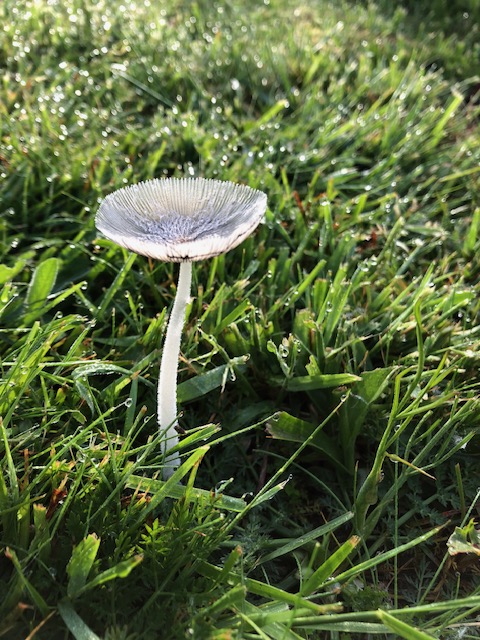

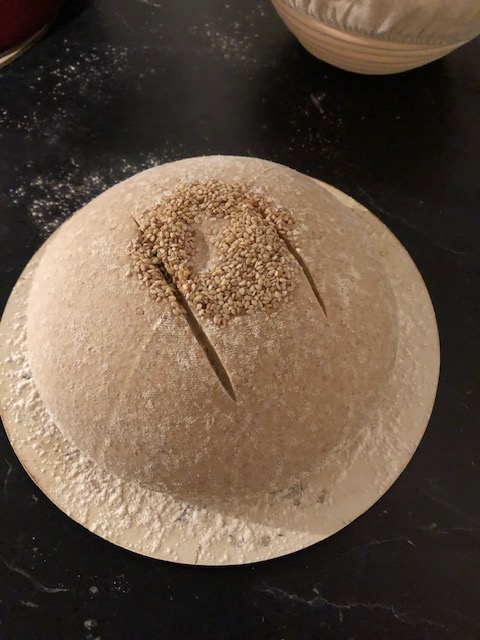
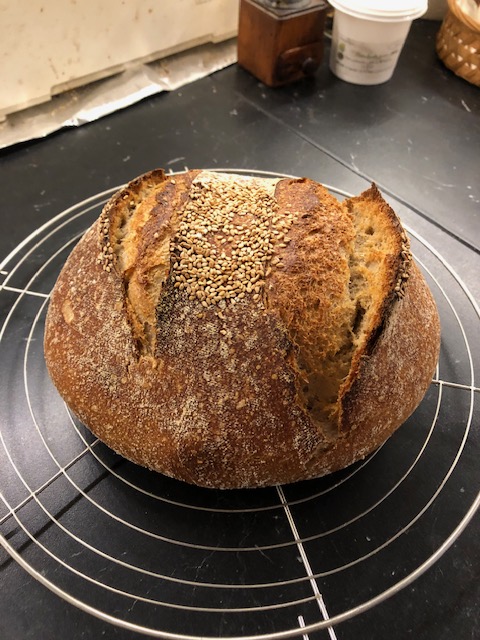


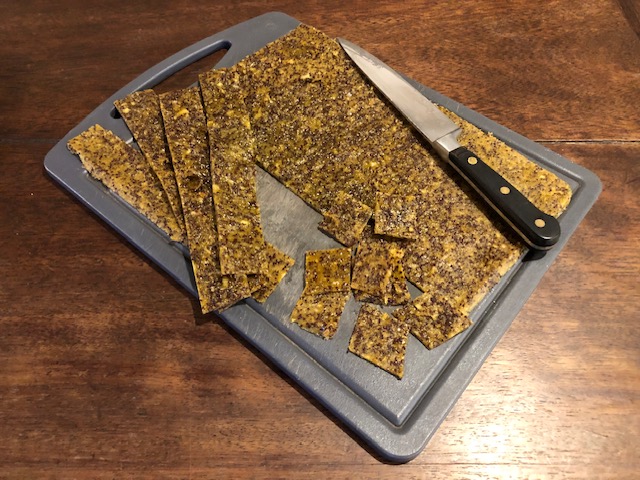
Forest Garden happenings, top to bottom and left to right: 1) an early morning encounter with this beautifully ephemeral and delicate mushroom, a Hare’s Foot Ink Cap, which despite its unusual name is very common! By lunchtime it had disappeared; 2) the effect of mowing the Forest Garden pathways. I will be limiting myself to one scything of the rest later on in the summer; 3) and 4) before and after baking; 5) a marigold uprooted at the end of a hügel bed, I’m assuming by deer, but it could be wild boar or a dog. Whoever it is, this is not the first time they have targeted marigold, for some reason; 6) a selection of bread flours from one of my suppliers, an artisan who grows and mills his own wheat. The brown bags are Rouge de Bordeaux, a local heirloom variety; 7) black cherry plum blossom, one of the first to appear in the Forest Garden; 8) pumpkin seeds drying before roasting. I have also done butternut seeds, and they are delicious; 9) a kiwi leather, made from a neighbour’s surplus organic crop. Kiwi will be among future crops planted here, as they do very well in this region and they are very nutritious.
I have at long last made a move to fill the gap left by the demise of my weather station almost 18 months ago. I had had high hopes for this instrument, with its promise of data transmission to my computer, and thus ease of producing weather record information, but it turned out to be just an amateur gadget, and didn’t last more than two years.A proper professional piece of equipment would be way beyond my means. In the 1990’s when first in France, I observed and recorded the weather manually in quite a detailed way for a good many years, and so I have now adapted this method, using an Excel spreadsheet, to produce records once more. It involves more work, as I have to physically record data each morning, but once figures are on the spreadsheet, I can easily produce totals, averages and bar charts on a monthly and annual basis. It also provides an at-a-glance impression of weather conditions over a given period. As you will see below, this was started in mid-March.
February and March were generally wet months (131mm and 118mm respectively), with the first half of April less so (25mm so far). Average temperature for March was 14.5° and to mid-April 15°, although maybe for the whole month this will be higher. The move into spring has been persistent, despite what has often appeared to be quite cold conditions morning and evening, but with higher temperatures during the day (once or twice into the upper 20’s). This has been particularly the case in April, with high pressure dominating.
Another new departure this year is the decision to use Carré 2 in the Upper Garden (one of the squares where I have been accelerating soil fertility) as a vegetable plot with a difference! My ambivalence about growing the usual annual vegetables remains, due to over-hybridisation of varieties, their relative lack of nutritive value and the fact that they are very demanding on both the grower and the soil. However, the seed supplier I use here, Kokopelli (excellent choice of organic, biodiverse, open-access seeds) has this year offered a ‘forest garden’ selection which appealed to me, with plants such as sunflower, amaranth, sorghum, radish, beetroot, dwarf cherry tomato, tetragonia (New Zealand spinach), fennel and dill plus a couple of flowering plants, poppy and agastache, the latter being a useful infusion plant.
This selection is interesting because it provides a full range of height and shelter from sun and wind (sunflower and amaranth) medium height (sorghum, fennel, dill and cherry tomato, with the addition of some French beans also), ground cover (tetragonia) and below ground (radish and beetroot), while at the same time giving nutritious food of many types, nitrogen-fixing and insect attractors in the flowering plants. Everything will be interplanted for maximum diversity and symbiosis.
Unfortunately, the carré will have to be fenced off against the deer, and this, with the continuing obligatory and unsightly protection of every new tree, shrub and other plant throughout the garden, has made me come to the reluctant decision to fence off the garden next year. There will also come a time in the not-too-distant future when the abundant fruit, nuts and other crops the Forest Garden produces will be attractive to two-legged ‘visitors’, and so fencing will be necessary against that too.
In spite of my comments above, I will nevertheless be growing just a few standard vegetable plants in the small potager I fenced off last year – tomatoes, aubergines, peppers, chilis, cucumbers – but again, these are from Kokopelli seeds and they will be mainly for making sauces and other preparations, as a complement to other freshly prepared food.
I have switched to mowing rather than strimming in the Forest Garden this year, and find it is much quicker and more satisfying. I am returning to mowing just the access pathways throughout the garden, leaving the rest for scything later in the year. Prior to the drought year in 2022, I had also left the longer grass for a single cut, but became alarmed at the parched nature of the grass during the drought, and the acute risk to my own property and those surrounding me of a sudden conflagration. Thus 2023 was spent chasing my tail (and reducing biodiversity in the process!) trying to keep the long grass shorter, and we ended up having a wet season! We’ll see how 2024 develops. A side benefit of mowing instead of strimming is of course that I get to use the clippings for mulch, and this has already been put to good use.
Besides the mowing, there has been a fair amount of general garden maintenance – weeding out unwanted invasives such as grasses in some areas, and wheat that germinated from the new straw used as mulch on the hügel beds, increasing protection on some shrubs such as the jostaberries which have outgrown the original netting, strimming awkward areas such as the roadside ditches, and so on.
I am happy to be continuing with the bread-making, it really is a joy, and the ladies that I have been instructing over the last few months (Blog, February 15, 2024) have got off to a good start; they now no longer need anything more than the occasional input from me. Mission accomplished but the community continues!
It is pleasing to see the Forest Garden and its associated concepts developing on multiple fronts, as I mentioned in the last Blog, and it is progressing well and in a balanced way. It is easy to feel impatient for the trees that I have planted to ‘get a move on’, but actually they are progressing rapidly in ‘tree-time’, and the fundamental garden infrastructure of mycelial development, decomposition, humus and hydrological development are all taking shape, even though I have to rely on the signs it gives me that this is happening! Planting will be on-going as the garden develops, particularly understory shrubs, herbaceous plants and climbers when the major trees become large and spreading enough to provide the semi-shade that the understory needs. The work done in the coppice this winter (Blog, February 15, 2024) is already a major step in this direction.
 The Sombrun Forest Garden Project
I recognise that impatience, Jonathan! It’s so easy to want things to hurry along so that the garden reaches a more mature feel but you are absolutely right, trees have their own time and we just have to be patient. It is lovely to see our young fruit trees in bloom this year and the native seedlings finally putting on growth and promising to create attractive woodland areas ~ no deer or hare attention this winter has helped. Fencing your patch will be a big task and it’s a shame it has to be done but your crops need protection and it would be devastating to lose them all. Hooray for annual food crops! I know you’re not keen but the Kokopelli seed selection is an interesting one and should give you some tasty bits and pieces for the kitchen. I am a great fan of New Zealand spinach. Good luck with the kiwi, we had one in Asturias and it was fantastic, we picked fresh fruit from November to March but my goodness, what a thug . . . The cuckoo was a week earlier than normal here, too, so it must be the year for it. Lovely to have them back and the swallows, too. Happy gardening and baking!
LikeLike
Thanks Lis, interesting from your blog to see we’re talking about the same things at the moment!
LikeLiked by 1 person