Taking stock …

I have always been optimistic about the establishment and progress of the Sombrun Forest Garden Project, and I hope this has always been reflected in the tone of the Blog. In its own gentle way, the project continues to move forward. There have been three notable advances this year:

In six years, the original walnut tree that I inherited has gone from a weak specimen to a healthy vibrant tree. This is not down to external inputs other than the application of urine, but to a general improvement in soil health and unseen mycelial activity. Worm activity has also become remarkable around the tree, and they are literally ploughing up the ground! The garden has come to the aid of the tree. This year there was the biggest crop of nuts ever, and for the first time, they matured properly and fell out of their green casings to the ground. Until now it was the whole, slightly immature unit that fell, and the casing browned and hardened around the nut on the ground, encouraging mould and burrowing insects, making it hard to get at the actual nut. And this new development has in turn led to a far higher percentage of healthy edible flesh when shelled, so far I would put it at higher than 90%.

Continue reading
Octopus Stinkhorn, or an ecological revolution taking place before my very eyes … !

Following on from this week’s Blog on the Wild Flower Census, momentous events are taking place in the Sombrun Forest Garden!

In conjunction with the Hügelkultur beds in the Upper Garden (Blog, April 15, 2023), I created a series of ‘mini-Hügels’ in Carré 4 in the Lower Garden (Blog of the same date), following the same principle (trenches, logs, branches, earth, compost), but with five beds close together over an area of about five metres square, and under some fruit trees.

In the year since this, the wood in the beds has begun to decompose and there have been several instances of fungi of various types showing above the ground on and around the beds, in both Upper and Lower Gardens. But by far the most spectacular are the ones below in the Carré 4 beds – Clathrus archeri, Octopus Stinkhorn, or Devil’s Fingers!

Continue reading

A new wild flower census, and the list is growing …!

Here’s a ‘bonus’ Blog to update you on the wild flower census, as it’s now two years since the last one, and I’m excited about the results! I’ve started using the PlantNet identification app for plants I’m not familiar with, as it’s easier and quicker than trawling through several plant books, plus species can be identified by the leaves as well as by flowers; you still need to treat the results with caution, as the app often includes several alternatives.

A case in point is the oddly-named Corky-Fruited Water-Dropwort (Oenanthe pimpinelloides), which I have mis-identified in the past as Queen Anne’s Lace or Wild Carrot (Daucus carota), but which I can see now is quite distinct. Both are white-flowering umbellifers, but the head on the former is flatter. Queen Anne’s Lace also has its immature flower head in the shape of an enclosed ‘basket’.

Continue reading

Spring, and a new weather recording system …

Spring came a little earlier this year – there were the first signs in the neighbourhood in early March, the greeny-brown tinge appearing on trees, a couple of weeks earlier than in recent years. The early flowering trees in the Forest Garden – almond, black cherry plum, apricot and peach – put on a good show around this time, along with the hazel and alder catkins and the goat willow. This was followed by the greengage, mirabelle and cherry in mid-March and fruit and forest trees started leafing out around this time too.

And then on March 25/26th, the cuckoo flower and the cuckoo put on their double act! This synchronism never ceases to amaze me, but it seems to be infallible, and they were a good week earlier than last year. A friend recently told me about the Merlin bird identification app, and while not needing it for the cuckoo, it is proving very useful and interesting for identifying other birds by recording their song, and giving me an indicator of species variety in the Forest Garden. For example, between April 11th and 13th, there were blackbird, blackcap, chaffinch, great tit, sparrow, goldfinch, robin and wood pigeon in several 30-second samples.

Continue reading

Forest Garden and Kitchen, another symbiosis …

In the second part of this Blog, I’ll be looking at the work that has been going on over the winter, both in the Forest Garden and in the Kitchen. As mentioned in previous posts, the forest garden concept includes a close association with what goes on in the kitchen, in terms of how the garden grows, its ecosystems (natural and assisted), what it produces, how this is transformed and its value nutritionally, and of the well-being provided in both garden and kitchen. There is also a community aspect, and I will come to this further down the page.

As you can now begin to see, the whole Project is broadening out as time goes on from just a simple exterior ecological project set within its landscape mosaic, to include food processing and cooking, baking and bread-making, nutrition, community and mental well-being. There will no doubt be further aspects added as time goes on. I made reference in Part One a few days ago to the subheading to the Project website title – ‘Small-scale Agroforestry in constant evolution’. Well, it’s certainly evolving, and in unexpected ways!

Continue reading

Momentous times, and Nature, the fountain of all knowledge …

Dear Reader, you’ve probably been thinking I’ve gone into hibernation, like the bumblebee above did, and in one sense you’d be right. It’s been a long pause since the last Blog in November, but a necessary one – a time for reflection, coupled perhaps with a bit of ‘writer’s block’. But in fact, far from burying myself away, I’ve had the most productive winter so far, not only physically in the Forest Garden as you’ll see, but personally also. I hope you will think that the wait has been worth it, because together, The Forest Garden and me, we have moved on – considerably!

Continue reading

Fungi, tree maintenance and nutritious food …

The hügelkultur beds created earlier this year in the Upper Garden (Blog, April 15, 2023) haven’t had much of a mention since, mainly because they have been left to start their work. Apart from some marigold (Calendula officinalis), French marigold (Tagetes patula) and red amaranth (Amaranthus spp.), nothing has been planted in the beds, as I wanted the soil and organic matter to settle around the logs and branches in the bottom of the trenches. There were some butternut squash on two of the beds, but the seeds must have been in the compost I used, and they came up by themselves!

But the big news is that there is plenty of fungal activity! There are several species – as yet unidentified – (photos below), and there will no doubt be more. This is a key sign that the decomposition process of the wood at the base of the beds is well under way, and that they will soon be able to be planted. Shrubs and herbaceous plants with smaller root systems can go on the beds, but bigger shrubs and trees will go alongside so that their more extensive and larger roots will not be disturbed as the beds sink further. These will still benefit as much from the moisture and nutrition the beds provide – their roots will search it out.

Continue reading

Harvest and heatwave …

I’ve chosen to publish this Blog on the Equinox, the first day of autumn. It’s an appropriate time to reflect on the summer, and in particular on what it brought in terms of crops and the weather.

Given the age of the Sombrun Forest Garden Project (four years since planting work really began), it’s gratifying to be getting some harvests in such a short space of time – even if in some cases they are very small … !

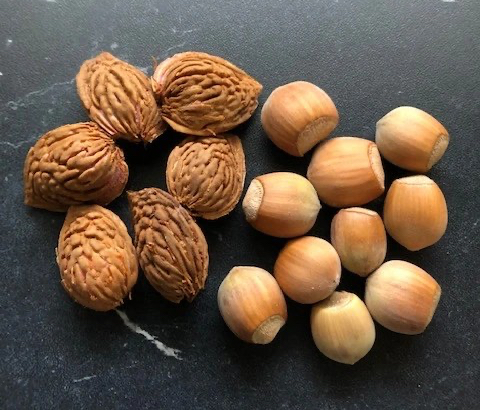
Almond and hazelnut harvest 2023 – well, it’s a start! I had forgotten the intensity of flavour in a fresh almond, and the beautiful design of the shell. The walnut planted two years ago (below) has just a single nut, but even this is surprising given its age (4 – 5 years) and the fact that walnuts can take up to 8 years to start producing fruit!

Continue reading

Forest Garden inventory update, and first real storm damage …

The Forest Garden inventory, first started four-and-a-half years ago, has been revised and updated. It was previously organised by area, but I realised that this could lead to duplication where there was a species in more than one area of the garden. So plants have now been arranged by type – hedges, forest trees, fruit and nut trees, fruiting shrubs and climbers, introduced flowering plants and perennial vegetables – and alphabetically this time. There are still one or two duplications, for example hawthorn, which is both in hedges and forest trees, but these are minimal. Nitrogen-fixing trees and shrubs are also indicated. As before, wild flowers are not included in the inventory, as they have their own.

With nearly 80 different species throughout the garden, all with their own degree of usefulness, it’s a good start for the Project, just over four years in, and a significant increase from the 50 species noted in the Blog, January 1st, 2021!

Continue reading

A lot of rain, and some difficult choices …

Since the last Blog in mid-April, we have had just over 220mm of rain, a lot! It was spread over the whole of this period, but with a peak from a series of heavy thunderstorms in the last 10 days. There was a particularly violent one on May 28th, when 44mm fell in just over an hour (there was probably more than this, because at one point it was falling so heavily that the opening of the rain gauge wouldn’t have been able to cope with it all). The storms, which usually occur at the end of a very warm afternoon, seem to have become a fixture, and are the result of a high pressure system which is stuck over the British Isles, blocking the depression over the whole of southern France.

The rain suits me just fine, because the garden is at last getting moisture at depth, something which it didn’t have for the whole of last year. And the result is clear to see. Suddenly, trees and shrubs appear to have put on a spurt (see photos below) and everything is looking vibrantly green and healthy. And in many cases this has coincided with the amount of time which trees planted two or three years ago need to really get their root systems established and to start showing proper growth.

Continue reading