Fungi, tree maintenance and nutritious food …

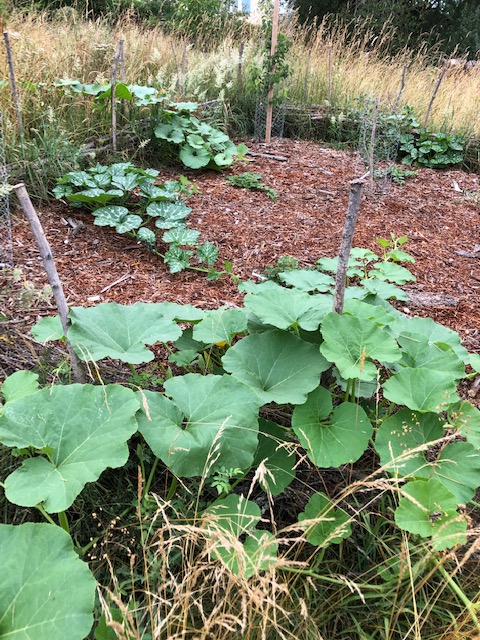
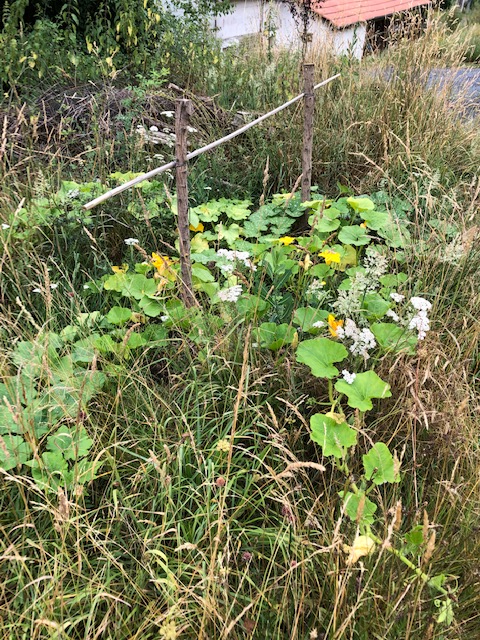
The hügelkultur beds created earlier this year in the Upper Garden (Blog, April 15, 2023) haven’t had much of a mention since, mainly because they have been left to start their work. Apart from some marigold (Calendula officinalis), French marigold (Tagetes patula) and red amaranth (Amaranthus spp.), nothing has been planted in the beds, as I wanted the soil and organic matter to settle around the logs and branches in the bottom of the trenches. There were some butternut squash on two of the beds, but the seeds must have been in the compost I used, and they came up by themselves!

But the big news is that there is plenty of fungal activity! There are several species – as yet unidentified – (photos below), and there will no doubt be more. This is a key sign that the decomposition process of the wood at the base of the beds is well under way, and that they will soon be able to be planted. Shrubs and herbaceous plants with smaller root systems can go on the beds, but bigger shrubs and trees will go alongside so that their more extensive and larger roots will not be disturbed as the beds sink further. These will still benefit as much from the moisture and nutrition the beds provide – their roots will search it out.

Continue reading
Forest Garden inventory update, and first real storm damage …

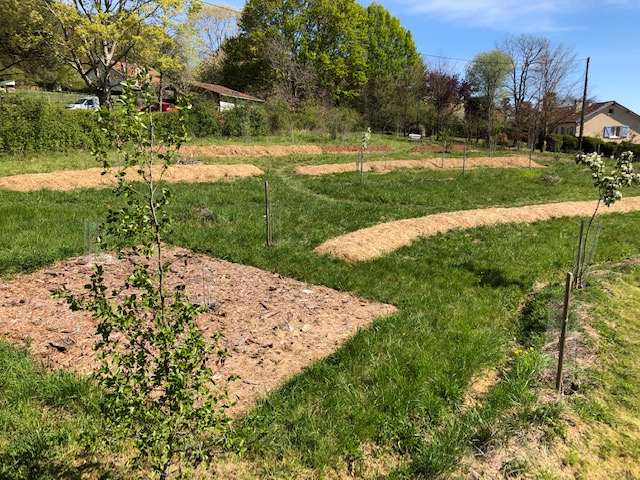
The Forest Garden inventory, first started four-and-a-half years ago, has been revised and updated. It was previously organised by area, but I realised that this could lead to duplication where there was a species in more than one area of the garden. So plants have now been arranged by type – hedges, forest trees, fruit and nut trees, fruiting shrubs and climbers, introduced flowering plants and perennial vegetables – and alphabetically this time. There are still one or two duplications, for example hawthorn, which is both in hedges and forest trees, but these are minimal. Nitrogen-fixing trees and shrubs are also indicated. As before, wild flowers are not included in the inventory, as they have their own.

With nearly 80 different species throughout the garden, all with their own degree of usefulness, it’s a good start for the Project, just over four years in, and a significant increase from the 50 species noted in the Blog, January 1st, 2021!

Continue reading

A lot of rain, and some difficult choices …

Since the last Blog in mid-April, we have had just over 220mm of rain, a lot! It was spread over the whole of this period, but with a peak from a series of heavy thunderstorms in the last 10 days. There was a particularly violent one on May 28th, when 44mm fell in just over an hour (there was probably more than this, because at one point it was falling so heavily that the opening of the rain gauge wouldn’t have been able to cope with it all). The storms, which usually occur at the end of a very warm afternoon, seem to have become a fixture, and are the result of a high pressure system which is stuck over the British Isles, blocking the depression over the whole of southern France.

The rain suits me just fine, because the garden is at last getting moisture at depth, something which it didn’t have for the whole of last year. And the result is clear to see. Suddenly, trees and shrubs appear to have put on a spurt (see photos below) and everything is looking vibrantly green and healthy. And in many cases this has coincided with the amount of time which trees planted two or three years ago need to really get their root systems established and to start showing proper growth.

Continue reading

Hügelkultur beds, suddenly it’s all happening …

First of all, thank you to all those who have been asking what has happened to the Blog! I’m trying out a policy of writing when there’s something happening, instead of following a strict monthly regime. But it’s reassuring to know that somebody out there is reading what I write!

And something really has been happening here in the last month! I had been waiting for the diggerman for the last few months to create the trenches for the planned Hügelkultur beds (see the last three Blogs for the background to this), and he finally turned up on February 9th; it was quite a wait, and I felt as though he was never going to come, but it was worth it! In just over an hour he created the three trenches for the new beds with great skill, and with the minimum of instruction (see photos below), and the bill was a lot lower than I was expecting!

Continue reading

The year in perspective …

I think 2022 was the year that the climate crisis really sank in for me. Quite apart from all the extreme events the world over, served up in copious helpings by the drama-hungry media, if I look back over the year, the one thing that really stands out is the drought we experienced here for over four months. As I wrote at the time (Blog, October 1st, 2022), it was a shock! It made me imagine all sorts of scenarios, right up to whether the land here would be able to support the Forest Garden Project if this was repeated regularly in the future.

The good thing to come out of this was the idea of installing hügelkultur beds in the Upper Garden, coupled with rainwater harvesting. This is still planned, but I am no further forward, waiting for the digger man to arrive. Unfortunately he is very good at his job (he has already done some work here), and so I think I must be further down the waiting list. I will wait until later on in January and then try him again. If that’s still no good, I will have to consider looking round for someone else, as the beds really need to be done before the spring. This involves such a fundamental change of direction, both physically and mentally, that until I can start, I feel as though things are in limbo, although my enthusiasm for the Project as a whole, and my overall long-term hope for an ecologically viable future for the planet, remain undimmed.

Continue reading

Very welcome rain, at last, and I move indoors …

November has been wet, so a quiet month in the Forest Garden, although there has been plenty of activity indoors. Soup- and bread-making continued, and I have been improving my understanding of both the levain and the dough, and trying different flours. The one I am using at the moment comes from a water mill close to the Pyrenees, where they still use the traditional stone ground method. Fascinating to see, and the flour is good, but sadly it is the only mill of its kind left in my département.

I have learned to refresh the levain for just a few hours (four or five) before starting the dough, so that it is at its peak activity. And I have tried making and baking in a single (long!) day, as well as leaving the dough to proof overnight in the fridge and baking the next morning, as mentioned last month. On the whole, the overnight proofing seems to work best, as there is more time to fit in other activities during the day with this method. It also gives the yeasts and gluten a longer and gentler development, and the resulting loaves seem to be more consistent.

Continue reading