The hügelkultur beds created earlier this year in the Upper Garden (Blog, April 15, 2023) haven’t had much of a mention since, mainly because they have been left to start their work. Apart from some marigold (Calendula officinalis), French marigold (Tagetes patula) and red amaranth (Amaranthus spp.), nothing has been planted in the beds, as I wanted the soil and organic matter to settle around the logs and branches in the bottom of the trenches. There were some butternut squash on two of the beds, but the seeds must have been in the compost I used, and they came up by themselves!
But the big news is that there is plenty of fungal activity! There are several species – as yet unidentified – (photos below), and there will no doubt be more. This is a key sign that the decomposition process of the wood at the base of the beds is well under way, and that they will soon be able to be planted. Shrubs and herbaceous plants with smaller root systems can go on the beds, but bigger shrubs and trees will go alongside so that their more extensive and larger roots will not be disturbed as the beds sink further. These will still benefit as much from the moisture and nutrition the beds provide – their roots will search it out.


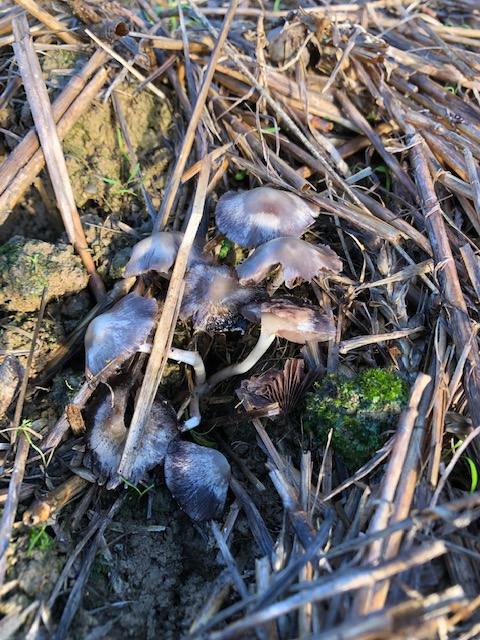

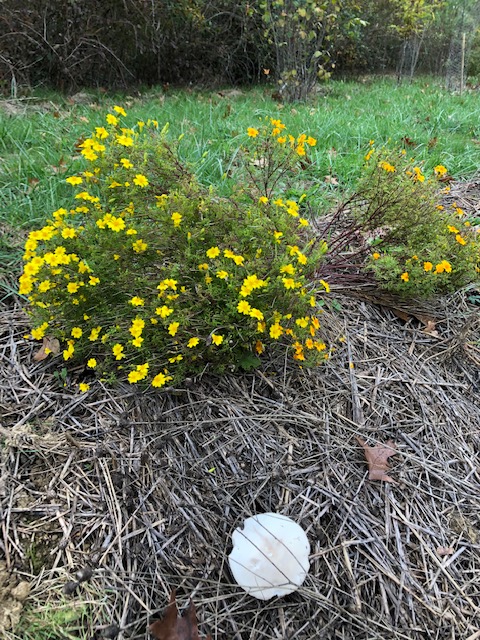

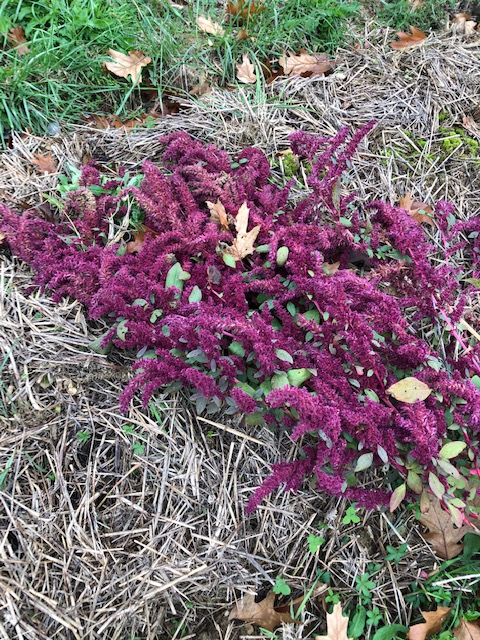
Top row: Several species of mushroom in the new hügelkultur beds. Bottom row: French marigold with mushroom, marigold and amaranth, still in flower in mid-November, were planted into the beds this year for their colour, but also for their utility as insect attractors/repellants and culinary use. The whole amaranth plant is very nutritious and the seeds make a quinoa substitute.
Mycorrhizal cultures, either bought or collected from rich forest soil, are available to help newly introduced plants, especially trees, get established. But out of the thousands of species around, you would never be sure that the one you introduced was compatible, symbiotically speaking, with the plant and its surroundings. Hence, in my view, ‘home-grown’, such as is going on right now in the hügel beds, is better, since you know then that you have the most suitable ones. It is also part of the ethos of the forest garden, of letting Nature decide!
The hügelkultur beds along with the swales in between them are providing the foundation for better soil ecosystems, health and fertility, and so everything and everyone benefits in the long-term. They are also a key factor in the water management strategy here, helping to retain moisture as the soil improves and humus levels rise. The Sombrun Forest Garden has a stony, free-draining soil, especially on the slopes of the Upper Garden, and so water retention is vital.
Now that the fruit and other forest trees planted three or four years ago are maturing, I have started a programme of pruning, to eliminate the early lower branches no longer needed and give the trees their structure for the future. After this, only minimal pruning, especially on stone fruits, will be required, and none on the forest trees. The Pomme d’Albret mentioned earlier this year (Blog, September 21, 2023), which naturally has drooping branches, will be getting some special support to stop it drooping quite so much and attracting the deer!
The programme also includes clearing round the base of the trees, adding some compost for a nutrient boost and then a good layer of mulch to help retain moisture in the summer. I have so far been using the last of a pile of bark mulch for this, but now I have a second large, round straw bale, so this will be used instead. The straw on the hügel beds also needs renewing; it has already started decomposing and is letting light through for weeds to germinate.
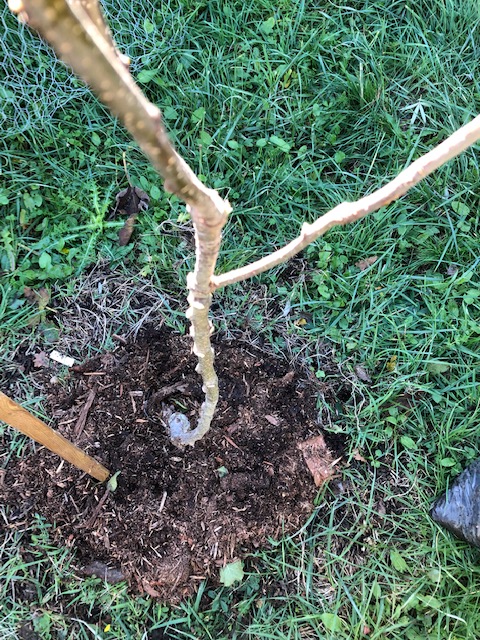
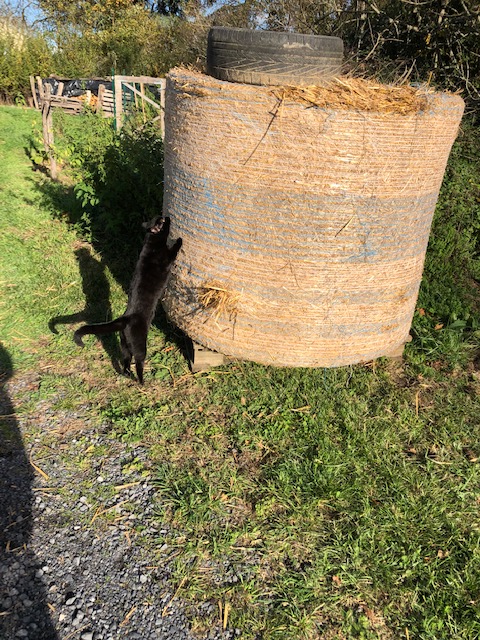

This apple tree in the Lower Garden (left) is on its second life after being severely ‘pruned’ by the deer. The original trunk is just behind the new stem at the base; compost and mulch will be gratefully received. Centre, Chanua (now three years old) about to climb up onto the new straw bale for an inspection. On the right, the black walnut (Juglans nigra) lost its centre stem to a fungus last winter and so its energy went into three side stems, which grew out almost horizontally. I have tied these to encourage them to grow upwards.
And then there will be some new planting. I have already put in the Kazakhstan apple (the ‘mother of all apple trees’, the wild original from which most of today’s varieties have been hybridised). This and the ungrafted cider apple trees (Blog, August 1, 2022) will provide valuable genetic diversity for pollination of the other apple trees in the Forest Garden. Other trees and shrubs to go in are a wild service tree (Sorbus torminalis), a second white mulberry (Morus alba), a Russian olive (Eleagnus angustifolia), sea buckthorn (Hippophae rhamnoides) and gooseberry (Ribes uva-crispa). I haven’t had much luck so far here with gooseberries, I’m not sure why, so a careful choice of site is needed to ensure that they don’t get burned in the summer sun, and have enough moisture and partial shade.
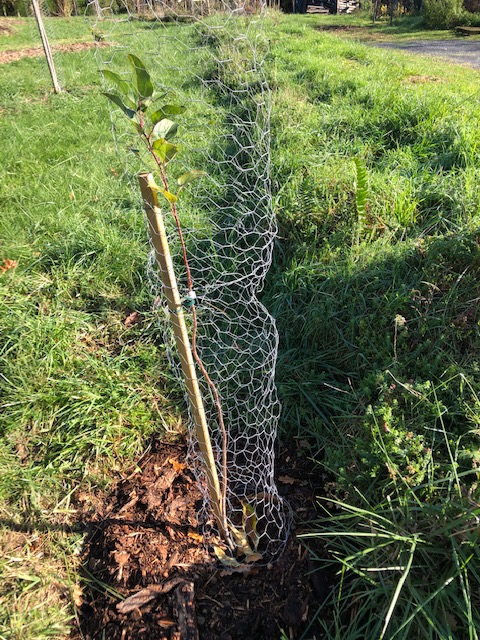
The Kazakhstan apple has been planted just behind the driveway bank in the Upper Garden, where there is a line of already well-decomposed woody material, and where the soil is reasonably moist.
In fact, soft fruit in general has had a tricky start in the Forest Garden. Last year I moved some blackcurrants, gooseberries and raspberries from full-sun positions in the Upper Garden, where they were about to give up, to a slightly moister and partially shady site in the Lower Garden. This year they put on a lot of growth, but no fruit, so hopefully next season will produce some results. Two jostaberries planted in Carré 1 are very happy and put on a lot of juicy shoots for the deer to nibble! I am seriously considering making cages for these, because the damage is considerable.
The whole garden has had an end-of-season tidy, involving strimming, mowing, cutting back a dogwood hedge along the top northern boundary which had started advancing a little too far into the garden, cutting back bramble, tall grasses and low branches in the coppice (north-east corner) and leaving them in situ to help increase the humus layer, weeding the carré beds and clearing gutters and drains around the house before winter. I have actually put back the black plastic mulch on Carré 3, as it had become invaded with bindweed; this is impossible to dig out and anyway I didn’t want to disturb the bark mulch layer on the surface. It is now necessary to get some ground cover plants and trees and shrubs into Carrés 2 and 3, in the same way as with Carré 1, so that the benefit of the previous years’ preparation is not lost. This has already begun on Carré 3, with two cider apple trees planted (below right).

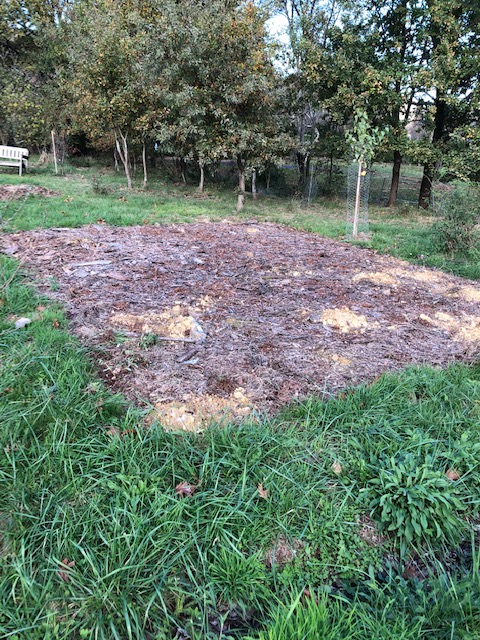

Carrés 1, 2 and 3; the ground-cover raspberry in Carré 1 has now spread to cover virtually the whole area. Compare this with the situation only five months ago (Blog, June 5, 2023). The policy of the last few years with these areas (black plastic mulch to clean the ground, nitrogen-fixing crops and bark mulch) has paid off, and they are now in a much more healthy state. The worms obviously think so too, their presence shown by the molehills in Carré 2 (centre).
Harvesting has continued since the last Blog, with a fair crop of squash, plus autumn olive, walnuts, apples, quince, rhubarb and a few late tomatoes! And to go with that, a fair amount of cooking and processing. The squash are stored indoors, and soup-making for winter supply is on-going. The autumn olives lasted long enough for me make a very tart but delicious fruit leather, reminiscent of sherbert from my schooldays! I found that boiling just the fruit and some water (no sugar added) for around 30 minutes reduced it to a thick enough consistency after straining, so that it spread firmly on the drying rack. After several hours in the dehydrator, it was rolled up and cut into bite-sized chunks. This year’s quince have provided compotes (mixed with apple, and in one case, blackberry as well), a nice jelly, and a ‘cheese’ which was far too sweet! Next year, I will reduce the sugar content by at least half!
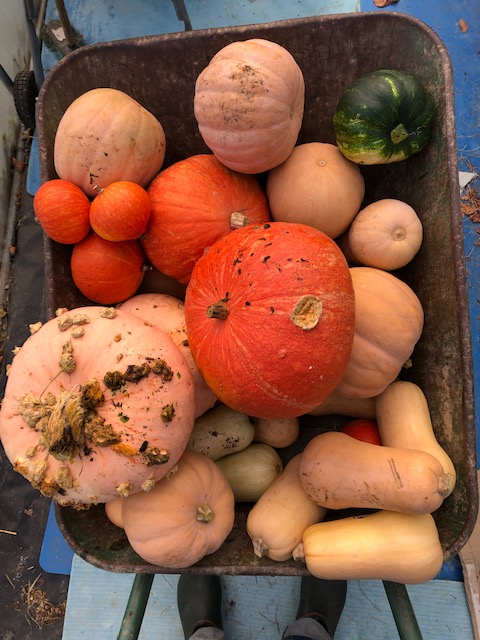

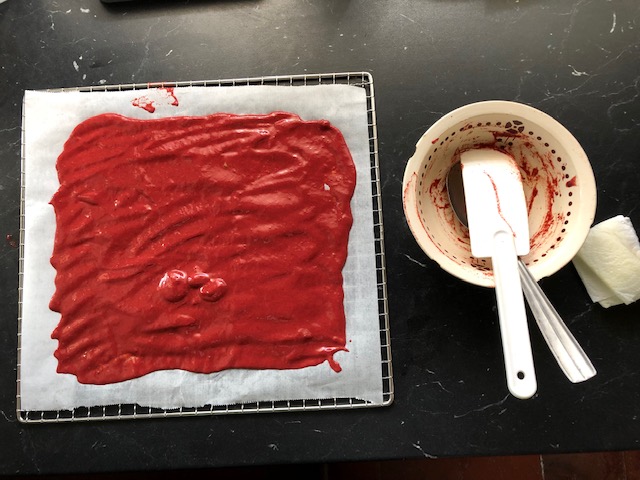


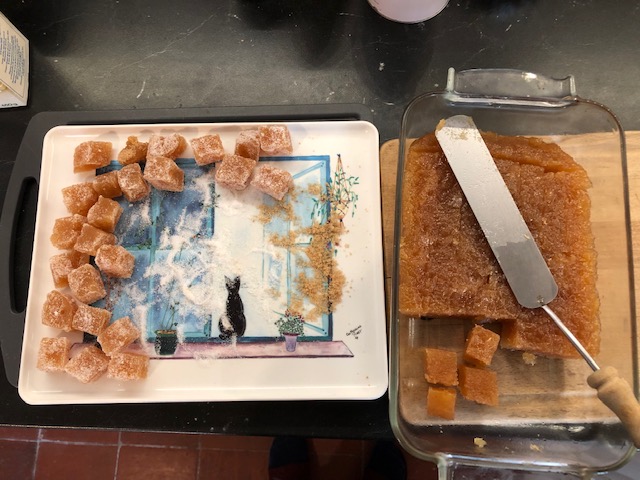
A selection of this year’s squash crop (top left). The mark on the pumpkin in the centre is from a large hailstone; three stages in the production of some autumn olive leather (top right); bottom, two quince products, jelly and quince ‘cheese’.
I have been making sourdough bread for over a year now, and am very happy with progress. I have four flour suppliers, all in the artisanal category, but with different milling arrangements, from an original water mill to modern stone grinding equipment. All produce very good flour and I have started to use an old wheat variety, Rouge de Bordeaux, from two of them. This was first known in France in the 18th century, but its use now seems to have spread worldwide. As a pre-industrial variety, it has the advantage of greater genetic diversity compared with modern, hybridised wheat, giving higher nutritive value and more complex flavour; I have found it makes very good, tasty bread.
Apart from this flour, I use modern wheat, rye and buckwheat, all organic. The categories of bread flour in France and other European countries are classified by colour, so T (type) 65 is whiter than T130 for example, corresponding to the flour’s ‘wholeness’. UK flours are required to add fortification, and so are categorised by their strength. I use the whole range of flours (T65, 80, 110, 130 and one supplier even makes a 150) in various combinations to experiment, but I always include some rye in the mix. And I experiment also with different types of bread; for example, recent loaves used milk instead of water to make an onion and bay loaf, and I have tried adding various seeds and dried fruit – recently I dry-roasted some sesame seeds and then ground them, and added this to the mix. This made a fairly ‘relaxed’ dough, possibly because of the oil released when grinding the seeds, but the final loaf was delicious.
As you will know by now if you are a regular reader, I consider good nutrition to be an integral part of the forest garden concept, and this is closely linked to my preference for perennial ‘crops’ rather than annual ones. It is perhaps not widely-known that wild and semi-wild foods are more diverse in their make-up and have higher nutritional content, in terms of vitamins, trace elements and fibre, than over-hybridised annual vegetables, even the so-called ‘super foods’. And so harvesting/producing, preparing and eating a wide variety of perennial foods, wild and domesticated, is a top priority. I still enjoy some annual crops, of course, but these are further down the list!
The Blog would not be complete without reference to the weather! Since I last wrote at the end of September, we have had an astonishing 275mm of rain, and compared to some areas of France, we have got off lightly. Not that I’m complaining, it was sorely needed, and we are now well set up for the winter. The weather in general has been fairly calm, with a pleasantly warm period in mid-October, when temperatures got into the high 20’s. Morning temperatures so far haven’t gone below 7° or 8°C.
There’s a recent TED talk I’d like to pass on, from Paul Hawken, founder of the Regeneration project (see Blog, January 1, 2022 for an introduction to this), and long-time environmental campaigner. It’s a talk about what we’re doing to our planet, but above all, it’s a passionate plea for regeneration, not just in forests and agriculture, but socially as well, in community. Regeneration is a non-stop mode of life, he says, and we need to be regenerative cultural farmers.
 The Sombrun Forest Garden Project
Interesting and inspiring as always. Thanks Jonathan
LikeLike
Thank you Gwen, for the feedback, much appreciated!
LikeLike
Hooray for hügelkultur! I was smiling reading about your new beds, those fungi are such a welcome sight. We had another incredible harvest from the squash planted on ours this year and we’re currently building a new one for some Styrian oil pumpkins next year. That said, we have fungi everywhere in the garden at present and I’m so happy that everything we are doing to build soil seems to be working. Your round up of news is as interesting as ever, a lovely harvest and the fruit leather looks delicious. Do you source the flour locally or buy online? I have drawn a complete blank trying to find organic grain here, we have our own mill but it seems everything goes straight to the food industry or is sold ready-milled. Our daughter brought us a good supply from the UK (still allowed post-Brexit, thank goodness) but it’s not an ideal situation. Thanks for the TED talk link, I shall certainly watch that when I have a chance.
LikeLike
Thanks, Lis, good to hear about your squash success. Yes, definitely the season for fungi, but most of mine are along the beds, so I’m happy with that. Seems you are in a flour desert! I do get all mine locally, and it’s organic, so maybe I’m lucky.
LikeLiked by 1 person
A very powerful and moving TED talk, a positive start to my day! Thank you for sharing.
LikeLike
Glad it spoke to you!
LikeLiked by 1 person