In the second part of this Blog, I’ll be looking at the work that has been going on over the winter, both in the Forest Garden and in the Kitchen. As mentioned in previous posts, the forest garden concept includes a close association with what goes on in the kitchen, in terms of how the garden grows, its ecosystems (natural and assisted), what it produces, how this is transformed and its value nutritionally, and of the well-being provided in both garden and kitchen. There is also a community aspect, and I will come to this further down the page.
As you can now begin to see, the whole Project is broadening out as time goes on from just a simple exterior ecological project set within its landscape mosaic, to include food processing and cooking, baking and bread-making, nutrition, community and mental well-being. There will no doubt be further aspects added as time goes on. I made reference in Part One a few days ago to the subheading to the Project website title – ‘Small-scale Agroforestry in constant evolution’. Well, it’s certainly evolving, and in unexpected ways!
Outside, a lot of work has been done in the ‘forestry’ department, and the Coppice and all the boundaries in the Upper Garden have been opened up. By this I mean that overgrown bramble, dogwood and dog-rose have been cut back, and lateral shoots and branches on the trees there (oak, ash, chestnut, hazel, lime, robinia, acacia, blackthorn and hornbeam), taken off up to about head height. Everything removed has been cut smaller and left on the ground as biomass.


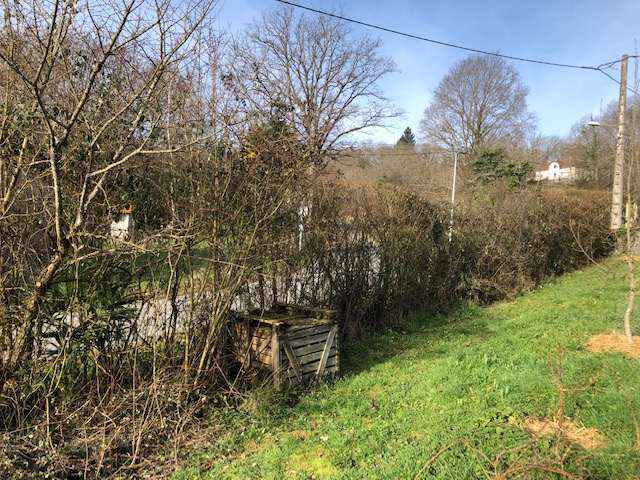


Clockwise, from top left: 1) the goat willow in October 2022; 2) the same tree (from the neighbour’s side) after cutting back this winter; 3) the roadside hedge in the Upper Garden after its annual cutback; 4) & 5) two views of the coppice after extensive clearing. The shrubs and bramble will be allowed to grow back again for ground cover and habitat underneath the trees. Notice the twigs and branches left to decompose on the ground; 6) the goat willow midway through cutting back, showing where stems have been removed, and those still to be cut. The only trunk now remaining is the one on the extreme right.
The aim with this work is promote the upward growth of the trees, allowing their trunks to broaden and become as straight as possible. When they achieve a useful size (for poles/posts/small beams/miscellaneous woodworking uses) they will be cut selectively to just above ground level (coppiced), meaning that there will always be a rotation of trunks cut, never a clear-cut. The coppiced trees will then send out new shoots from the stump, of which the two or three strongest will be retained to produce new trunks in their turn. And so on, always regrowing, always with tree cover. The goat willow in the photos above will be a sort of hybrid, in the sense that I have left one mature trunk (rather like ‘Willow Pattern’ china, don’t you think?!), but new shoots, particularly as it’s a willow, will soon grow up from the cut stumps and will be thinned as for the oaks.
The biomass left on the ground will decompose to provide humus, enriching the soil. In various places forest perennial crops such as wild garlic (Allium ursinum) or Good King Henry (Chenopodium bonus-henricus), which like the shade, will be planted and allowed to proliferate. Wild flowers will re-establish themselves. The bramble, dogwood, dog-rose and some blackthorn will grow back and thicken up to provide habitat for insects, birds and other smaller mammals, arthropods, worms, bacteria and microbes – in other words a true forest ecosystem! This is why I get so enthusiastic about the forestry side of the Project.
The alternative to coppicing is pollarding (see Blog, January 1st, 2021), where the tree top is cut off at maybe 2m from the ground. This utilises the same principle with new shoots as the coppicing, but it has the advantage that juicy new shoots are out of reach of browsers. I will no doubt have browsing of ground-level shoots in the Coppice in the future from my deer visitors, but we’ll cross that bridge when we come to it! The photo below shows one of three oaks that I have pollarded, because they are underneath overhead cables and were beginning to grow too close.

While all the above was going on, I was also spreading new straw onto the three hügelkultur beds (the first lot had already partially decomposed in less than a year), and as mulch around all the trees that I have planted, as a safeguard against possible drought this summer. I also gave each tree a nutrition boost of compost before mulching. The straw bale was not organic, and so probably contained some degree of herbicide (it’s ‘les grandes cultures’ around here unfortunately); it was a calculated choice, because organic straw is impossible to get hold of, but any herbicide will have partly leached out before it was baled, and the straw is now spread out exposed to the weather, which will continue that process.

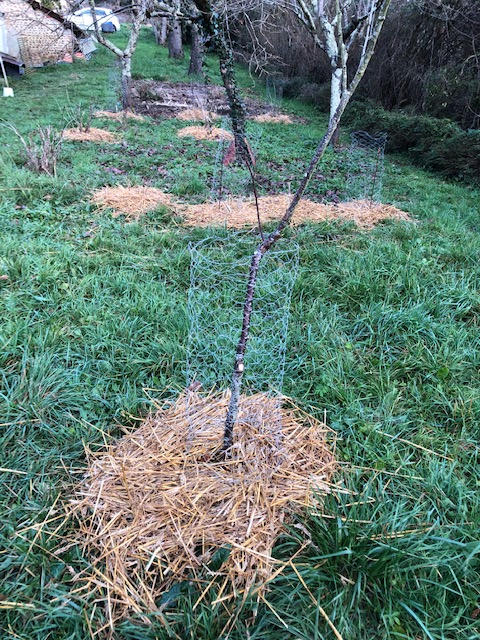

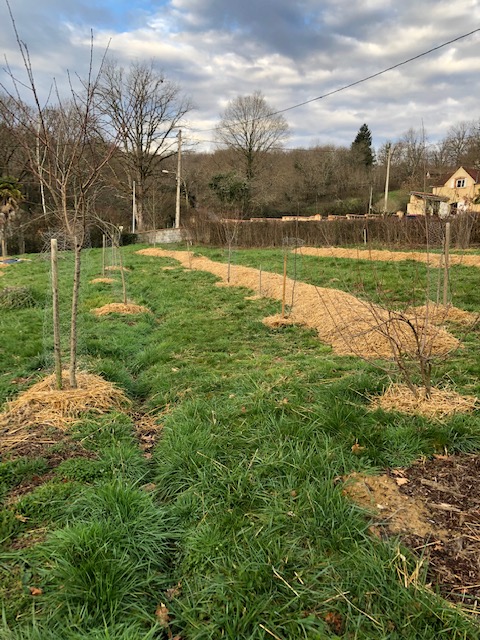
I have purposely not done any planting of shrubs on the hügel beds yet, to allow the woody material in them to decompose, and the beds to sink, further, but several trees and shrubs from my ‘pépinière’ here were planted alongside so that they can get established (next to the bed in the centre of the large photo above). These included a wild service tree (Sorbus torminalis), a second white mulberry (Morus alba), a Russian olive (Eleagnus angustifolia), and a couple of sea buckthorn (Hippophae rhamnoides), respectively a forest species, a fruit and salad-leaf tree (see book review below), and two nitrogen-fixers.
And so to the weather! The last three months have been remarkably mild and calm, we have had an almost equal amount of dull and sunny days, and there has been only one episode of stormy, blustery weather, last weekend. As I write (February 15th), it is mild and several trees are coming into blossom (black cherry plum, almond and of course the hazel catkins; the wild cherry and goat willow will not be far behind). The average minimum temperature from mid-November to mid-February has been around 7°C, with only 13 mornings of frost. The lowest temperature was -4° on January 20th. There was 1238mm of rainfall in 2023, a generally wet year, and this compares with the 743mm we had in 2022, the drought year. For the first six weeks of this year, we have had just 94mm of rain.
Coming inside to the kitchen, I hope you will excuse me for talking a lot about sourdough bread-making in the Blog! After 18 months, I still find it a rewarding and absorbing task, and it fits very well within the whole Project concept, providing nutritionally excellent, sustainably produced food, with the added benefit of increasing one’s personal well-being through the processes of preparing it and working with a growing organism. The wheat, rye and buckwheat flours and other ingredients used in my loaves, biscuits and buns are organic and often from pre-industrial heirloom varieties with high genetic diversity, and the wild, fermented yeasts from these flours are beneficial for our bodies, much more so than store-bought dried yeast, or even fresh yeast from a baker, which are both much less diverse.

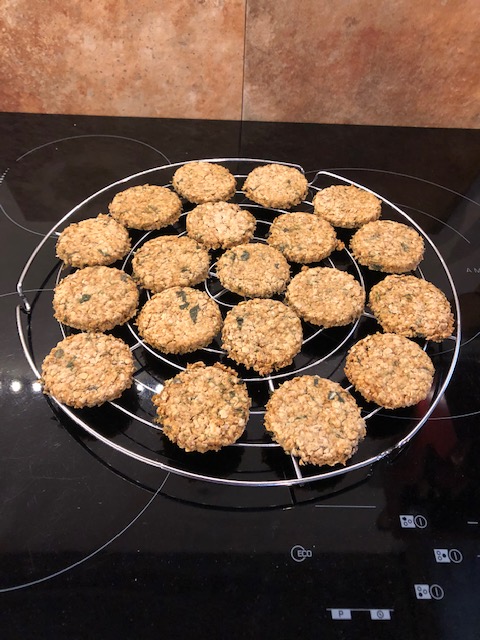

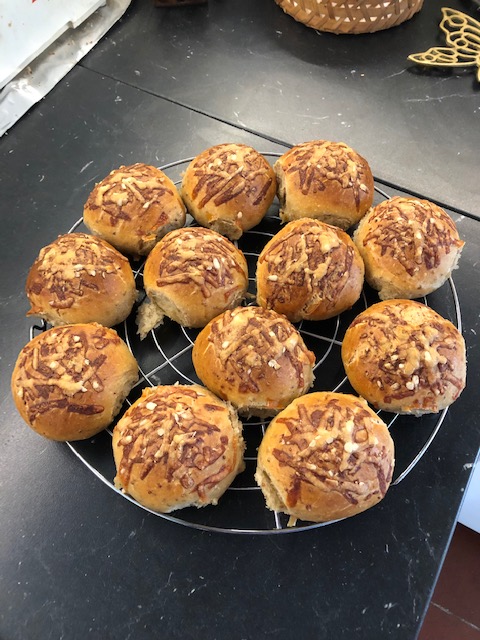

A selection of recent baking, left to right, top to bottom: a 1kg loaf using standard (T65) and rye flours plus dry-roasted sesame seeds; nettle oatcakes; a fig and walnut loaf; mustard and parmesan buns; and chocolate chip cookies. The cookies were made with sourdough starter discarded during the refreshing process, where a quantity of the levain is removed before adding new flour and water to restart its fermentation. This is a good way of getting a second use from the levain rather than throwing it away.
I now belong to a WhatsApp social group locally, and they heard about the bread-making activities here; the result was that I was asked to start a sourdough class, and so far have instructed five ladies on creating a sourdough starter. This should then lead to full bread-making, and the exchange of ideas and recipes that that will entail; for example, the use of the starter discard mentioned in the photo caption above was new to me, and came from a group discussion. As mentioned above, community is another arm of the Forest Garden concept, and the sharing of something I have learned for the benefit of others, is an integral part of that and very rewarding.
I do produce a lot of soup here, because it is simple to make, is almost entirely from garden produce, and is very tasty and nutritious. Fresh food that I buy is always direct from the grower, or from a local market (which amounts to the same thing), and never from a supermarket; for more on this subject, see Article No. 2, Sustainability: what does it mean exactly? on this site. Fish and the small amount of meat that I buy are also from the markets, of better quality and fresher.
One very useful book I have come across recently is Trees with Edible Leaves from the American Perennial Agriculture Institute. It is by Eric Toensmeier1, who is a well-known researcher and writer on edible perennial crops. The book has a global scope, and includes an introduction to edible tree leaves and growing them, trees for different climates, and nutrition information. I have been aware of this crop for some time, but have only relatively recently begun planting. So far I have white mulberry (Morus alba), small-leaved lime (Tilia cordata), a very small goji berry (Lycium chinense) and silver birch (Betula pendula), plus a grape vine in climbers. As you will see from Toensmeier’s book, edible leaves have significant amounts of minerals, vitamins and trace elements and make a tasty addition to salads. The book is free to download here:
This double Blog started off , and continued, with new beginnings and a note of hope, and I would like to end in the same way with a quotation from a book I have just finished reading – Under the Rock2, by Benjamin Myers, a British novelist, chronicler and poet. It’s an account of his life in the Upper Calder Valley, Yorkshire, UK, and is centred around Scout Rock, a huge rocky outcrop; he manages to make all sorts of natural and ordinary things sound magical.
“The rewilding of Scout Rock is born out of neglect, and is nature’s fight-back against the centuries of industrialisation. It makes me believe that once we, the planet’s custodians, find our future numbers drastically reduced and living artificial existences due to the destruction of our natural resources – or perhaps destroy ourselves entirely – earth will slowly repair itself and begin all over. Rain will fall, its acidity chipping away at the rock to form new sea beds, new deserts. Cells will evolve. Seeds will take root. New species will emerge. A version of humans, perhaps.
“Maybe next time we’ll do things differently.
“Maybe we’ll do things exactly the same.
“But life will sing its song again.”

1 See also his Perennial Vegetables – Toensmeier, E. (2007). Perennial Vegetables, Chelsea Green Publishing, Vermont, USA.
2 Myers, B. (2018). Under the Rock, p. 358, Elliott and Thompson Ltd, London.
 The Sombrun Forest Garden Project
Isn’t it amazing where this sort of living can lead? How wonderful to be sharing your knowledge and experience of sourdough, it’s just how a community should be! All is looking good in the Forest Garden, there is most definitely a sense of growing maturity about it which is both satisfying and exciting. I share your thoughts on straw, I don’t buy any here because I can see all too clearly what is applied to the crops but we have enough space to cut plenty of our own hay which is left for a year to age before using as a mulch. Thanks for sharing the book, it’s an interesting read; I have to admit, young hawthorn leaves are one of the treats I look forward to every spring! Beautiful quotation from Benjamin Myers, too.
LikeLike
Thank you Lis!
LikeLiked by 1 person