Following on from this week’s Blog on the Wild Flower Census, momentous events are taking place in the Sombrun Forest Garden!
In conjunction with the Hügelkultur beds in the Upper Garden (Blog, April 15, 2023), I created a series of ‘mini-Hügels’ in Carré 4 in the Lower Garden (Blog of the same date), following the same principle (trenches, logs, branches, earth, compost), but with five beds close together over an area of about five metres square, and under some fruit trees.
In the year since this, the wood in the beds has begun to decompose and there have been several instances of fungi of various types showing above the ground on and around the beds, in both Upper and Lower Gardens. But by far the most spectacular are the ones below in the Carré 4 beds – Clathrus archeri, Octopus Stinkhorn, or Devil’s Fingers!

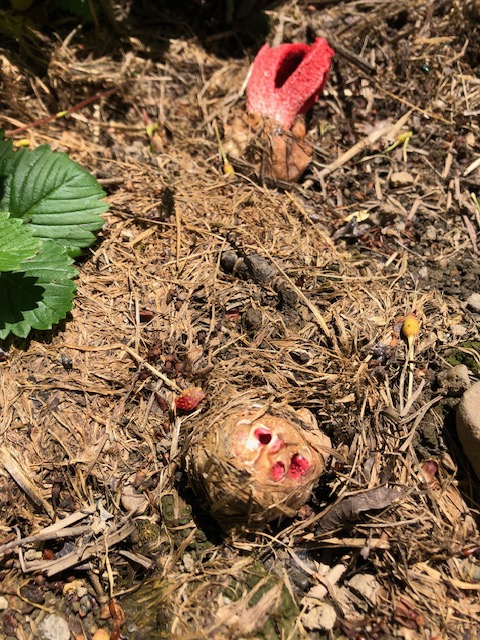


Development of the Octopus Stinkhorn, left to right, top to bottom: 1) the first fungus growing out of its first-stage sheath; 2) the egg-shaped sheath of the second one; 3) the tentacles breaking out of the sheath; 4) fully developed fungus showing the black, sticky mucus which attracts flies.
The Wikipedia description covers what is going on here:
“Clathrus archeri produces compounds similar to the scent of rotting flesh ….. used by the fungus to attract flies to serve as agents for spore dispersal ….. (and) is commonly found in environments with abundant decaying organic matter ….. The species is believed to be endemic to southern Africa, New Zealand and Australia, but has been spreading to other continents and is often invasive. Clathrus archeri now has a global distribution and has been naturalised in Europe and North America ….. As climate changes drive niche habitat loss, (it) is expected to become threatened in Australia but is expected to expand to northeast Europe …..
“Clathrus archeri grows best in environments rich in decaying vegetation ….. It is most commonly found in leaf litter or mulch below vegetation. The most abundant acid secreted by the fungus is oxalic acid, this acid binds to metal cations and increases the bioavailability of some minerals. Fungal mycelium exhibits calcium pooling which changes soil pH and availability of phosphorus for surrounding flora …..”
And finally, on a gourmet note – “Due to the rotting stench of stinkhorns, there are no common culinary applications” (!) .
An ecological revolution? Well, yes, on several fronts. First, on a global scale, due to climate change, the habitat of the fungus is moving from Australasia to spread across the world. Giga! Secondly, at a local level, we see that the Octopus Stinkhorn prefers an environment rich in decaying vegetation; that has been provided here, and it has decided to show up! Gulp! Thirdly, it is not only taking part in the spread of the mycelial network and the general ecological development here in the Forest Garden, but, through further chemical action, it is helping to improve the soil by making minerals more available to other plants. Gosh! And fourthly, the flies attracted by its putrid smell land on the black, sticky mucus containing the spores, fly off again and so spread the spores wider afield. Golly! How amazing is that?
There is a very good time-lapse video on the development of the fungus here: https://www.youtube.com/watch?v=OjiKQ55HHpY
Pardonnez-moi, chers lecteurs, amis, collègues français (tous genres confondus!), mais vous ne trouvez pas les noms communs anglais plus intéressants, descriptifs et imaginatifs que leurs équivalents français, très souvent inspirés par le nom latin, et qui est dans ce cas, Anthurus étoilé? Prenons aussi l’exemples de Carotte sauvage (Queen Anne’s Lace en anglais), Gaillet jaune (Lady’s Bedstraw), Oenanthe faux boucage (Corky-Fruited Water Dropwort), Rhinanthe mineur (Yellow Rattle), ou bien Piloselle (Mouse-Ear Hawkweed).
And finally, one of my favourite wild flowers, the Spreading Bellflower (Campanula patula) has shown up in the two or three days since the census was published, so here it is:

Génial, non?
 The Sombrun Forest Garden Project
Si belle ! The first time I came across the Octopus stinkhorn was when we lived in Asturias, there was a patch of local woodland where they appeared each year ~ and boy, did they smell! A really fascinating species, though, and you must be delighted about such an interesting new development in the forest garden.
LikeLike